AI Bubble: The Truth, How It Affects You, and What You Should Do
Credit: Towards Data Science
By Epiphanus Obia
Walk into any tech hub in Nigeria today, or engage any techie, and you’ll hear the same conversation. Entrepreneurs, investors, and tech professionals, who’ve spent years insisting artificial intelligence (AI) will change everything, are now admitting something uncomfortable: we might be in a bubble.
What Exactly Is the AI Bubble?
Think of a bubble like this: Imagine everyone in your estate or neighbourhood suddenly decides that investing in solar panels would revolutionise how we live. A few early users install them and genuinely benefit from lower NEPA bills. Word spreads. Soon, people are paying ₦5 million for premium solar systems. Investors are funding solar farms the size of football fields. Everyone’s talking about the “solar economy.” Then one day, someone asks: “Wait, can we all really afford to maintain these systems? Is the return worth it?”
That’s essentially where we are with AI globally, except instead of solar panels, we’re talking about hundreds of billions of dollars.
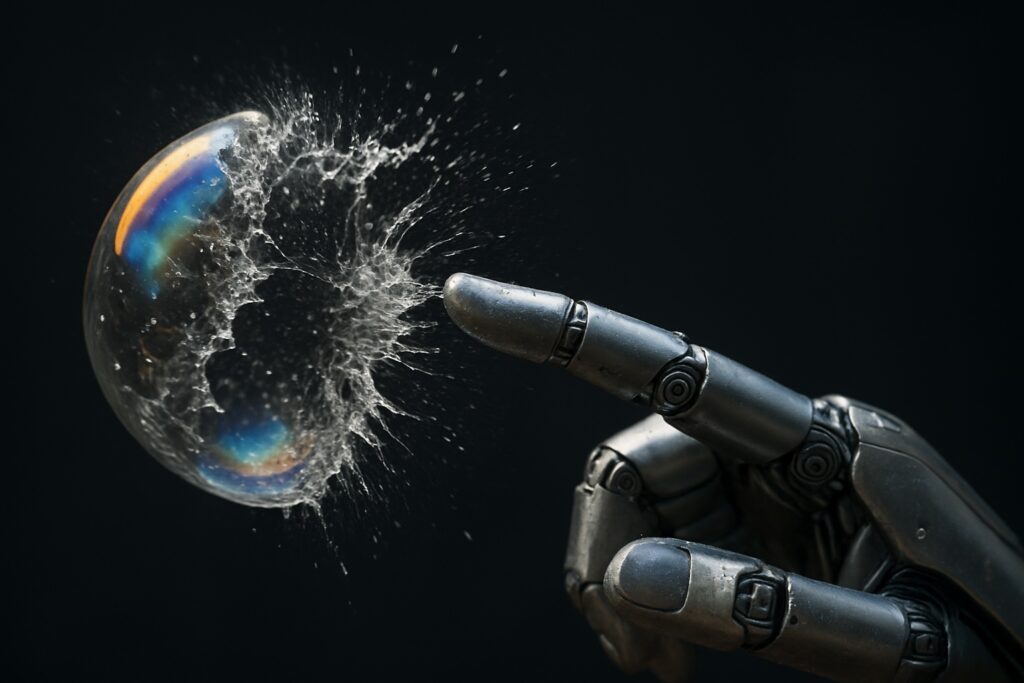
A bubble happens when the price of things, such as stocks, real estate, or technology, rises far beyond their actual value because people believe they will keep rising forever. The problem is not that the thing has no value. Solar panels do reduce electricity costs. AI can do useful things. The problem is when the gap between reality and expectations becomes too wide to sustain.
The Numbers Are Mind-Blowing, Everyone’s Spending
OpenAI, the company behind ChatGPT, plans to spend $500 billion building AI data centres. To put that in perspective, that’s about ₦727 trillion, more than Nigeria’s entire GDP for several years combined.
Sam Altman, OpenAI’s chief executive, has told employees the company wants to build enough computing capacity to match India’s entire national electricity demand. The price tag? More than $12 trillion (roughly ₦19.8 quadrillion naira).
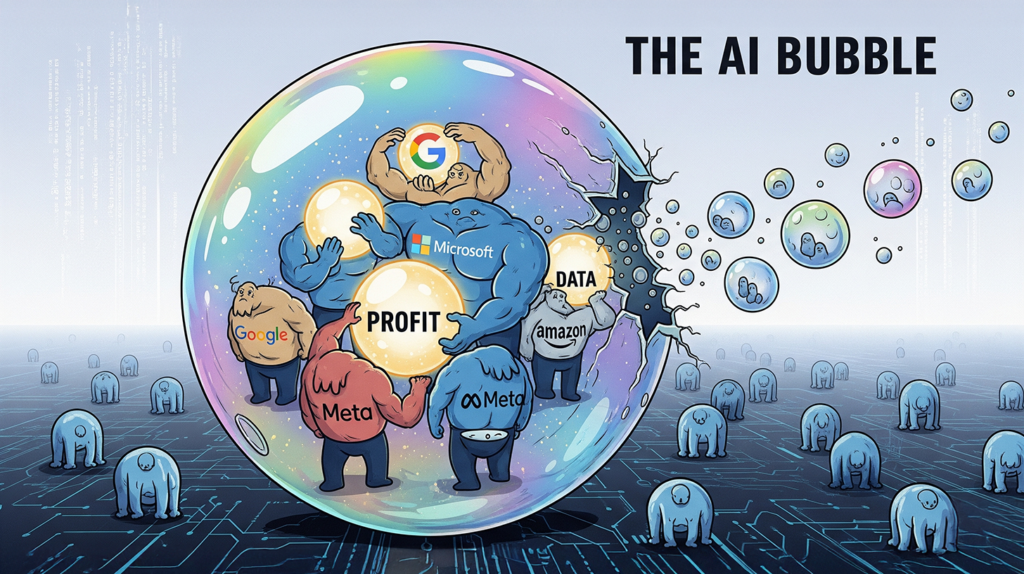
These aren’t small startups making wild promises. These are the companies leading the AI revolution, and they’re spending money at a pace that makes past tech booms look like child’s play.
Here’s where it gets interesting. The tech leaders pouring money into AI will tell you that yes, this looks like a bubble, and yes, they’re still going to keep spending anyway.
Mark Zuckerberg, Meta’s CEO, put it bluntly: If his company wastes a couple of hundred billion dollars on AI, that would be unfortunate. But the bigger risk, he argues, is spending too little and falling behind competitors.
This thinking is driven by a real problem: there aren’t enough computer chips and data centres to meet demand. AI companies are genuinely bottlenecked. Every tech CEO will tell you they need more computing power. Startups can’t get the processors they need. The big companies are rationing resources, saving them for their best customers.
If this shortage is real, then maybe the massive spending makes sense. But there’s a catch.
Will There Ever Be Profit?
Here’s the uncomfortable truth that separates this bubble from your typical hype cycle: most AI companies aren’t making money. They are just burning through cash.
Amazon lost about $3 billion before turning profitable. Tesla burned through $4 billion. Uber, which seemed to lose money endlessly, burned $30 billion before finding its footing.
OpenAI is projected to burn through $140 billion by 2029. Anthropic, its main competitor, could burn $20 billion by 2027. These numbers aren’t just big; they are in a different universe from past tech losses.
And here’s the kicker: analysts estimate that to justify all the money being spent on AI infrastructure, the industry needs to generate $2 trillion in annual revenue by 2030. That’s more than the combined 2024 revenues of Amazon, Apple, Google, Microsoft, Meta, and Nvidia.
For context, that’s roughly equivalent to the entire GDP of Africa.
What This Means for Nigerian Businesses
You might be thinking: “I don’t invest in American AI startups. Why should I care?”
Fair question. Here’s why it matters to you.
Nigerian businesses are already integrating AI into their operations. They’re paying for ChatGPT subscriptions, using AI tools for customer service, hiring consultants to implement AI strategies, and restructuring workflows around these new technologies. Many are spending significant portions of their limited capital on these tools.
A recent study by MIT found that 95% of organisations investing in generative AI saw zero return on that investment. Zero.
If the bubble bursts globally, here’s what could happen locally. The AI tools your business depends on might disappear overnight when foreign startups fold. Those expensive AI consultants pushing “AI transformation” might have been selling you solutions to problems you didn’t have. The competitive advantage you thought you were building by “being early to AI” could evaporate if the technology doesn’t deliver on its promises as quickly as everyone hoped.
Then there’s the employment angle. Many Nigerian companies are now hiring based on what they believe AI will be able to do. Some are holding off on hiring, expecting AI to fill the gaps. Others are considering letting people go, betting that AI assistants can handle the work. If AI doesn’t deliver at the pace and scale expected, businesses could find themselves understaffed and scrambling.
What It Means for Nigerian Workers and Job Seekers
The AI bubble affects Nigerian workers in contradictory ways. On one hand, some companies are investing in AI tools, claiming they’ll make workers more productive and free them from tedious tasks. On the other hand, there is constant talk about which jobs AI will replace.
For Nigerian professionals, whether you’re a content creator, customer service representative, accountant, or software developer, the uncertainty is real. Every week, there’s a new headline about AI potentially replacing your role.
The honest answer is that nobody really knows yet. The technology is advancing rapidly, but it’s also hitting limitations that aren’t always obvious from the outside. AI can write emails and generate images, but it still struggles with tasks that require genuine reasoning, deep cultural context, or physical-world interaction.
Think about it: Can AI navigate the complexities of Nigerian bureaucracy? Can it communicate with customers who speak Pidgin, Yoruba, Igbo, or Hausa? Can it handle the real-world problem-solving required when NEPA takes light in the middle of an important task?
If the bubble bursts, the immediate effect on workers might actually be relief. The pressure to constantly adapt to new AI tools could ease. The fear of imminent replacement might subside. But there’s a downside: if AI investment collapses globally, it could drag down the broader tech economy, affecting Nigerian tech companies that depend on foreign investment and international partnerships.
The Technical Uncertainty
There’s another layer of risk that’s easy to overlook: nobody’s entirely sure which technical approach will win.
Today’s AI is built primarily on large language models, systems trained on enormous amounts of text that learn to predict what word comes next. These models are impressive, but they have limitations. They struggle with genuine reasoning. They can’t learn from experience the way humans do. They don’t understand the physical world.
AI researchers are pursuing different paths to overcome these limitations. Some are working on AI that can understand physics and interact with the real world. Others are focused on systems that can learn more like humans do, through trial and error. Still others think we just need to make current models bigger and bigger.
The uncomfortable reality is that we’re spending hundreds of billions of dollars without knowing which approach is correct. What if all this investment is backing the wrong horse? What if the breakthrough that actually delivers on AI’s promises comes from a completely different direction?
When Might The Bubble Pop?
Goldman Sachs, the investment bank, says today’s AI market looks like tech stocks did in 1997, several years before the dot-com crash. The warning signs are not red yet, but they’re turning yellow.
Bubbles typically burst when reality catches up with expectations. That could happen in a few ways:
Revenue reality: If AI companies can’t generate enough income to justify their spending, investors will eventually stop funding them. When the money runs out, companies fold, people lose jobs, and the ecosystem contracts rapidly.
Technical plateau: If AI capabilities stop improving as quickly as expected, the gap between what was promised and what’s delivered becomes obvious. Companies that bet big on AI solving problems it can’t actually solve will find themselves in trouble.
Economic shock: A global recession, a financial crisis, or even just rising interest rates could make investors more cautious. When money gets tighter, risky bets on future potential become less attractive. For Nigerian businesses already dealing with forex pressures and economic uncertainty, a global AI crash would add another layer of stress.
The strange thing is that many of the people building this bubble openly acknowledge these risks. They just believe the alternative, not spending enough and falling behind, is worse.
What Should Nigerians Do?
For most Nigerians, the right move is probably: stay informed but don’t panic.
If you’re a business owner considering AI investments, ask hard questions. What specific problem does this solve for your Nigerian customers? What happens if this foreign vendor goes out of business? Can you measure the return on investment in naira terms, or are you investing based on fear of being left behind? Given forex volatility, can you afford a dollar-denominated subscription if the naira weakens further?
Remember that your competitors might be hyping their AI adoption on social media, but that doesn’t mean they’re actually seeing returns. Don’t let FOMO drive expensive decisions.
If you’re a worker worried about AI replacing your job, the honest answer is that it’s too early to know. But developing skills that AI struggles with, creative problem-solving, emotional intelligence, understanding local context, managing complex human relationships, and navigating the unique challenges of operating in Nigeria, is probably a good bet regardless of what happens with the bubble.
The irony is that many roles that seem vulnerable to AI in America or Europe might be safer in Nigeria, precisely because of our unique challenges. AI can’t handle the relationship management required in Nigerian business. It can’t navigate the complexities of our regulatory environment. It can’t adapt to the constant pivoting required when infrastructure fails.
If you’re a tech professional or entrepreneur, the lesson from past bubbles is clear: the technology usually is transformative, but most companies don’t survive. Being early doesn’t guarantee being right. Building sustainable businesses with real revenue, even if it’s not “sexy” AI stuff, might be smarter than chasing the hype.
If you’re a young Nigerian wondering whether to pursue AI-related education or training, the answer is not straightforward. Understanding AI is valuable. But don’t abandon other valuable skills or traditional education paths because of AI hype. A broad skill set will serve you better than a narrow specialisation in a technology that might evolve in unexpected directions.
The Nigerian Perspective
Here’s what makes this particularly important for Nigeria: we’ve been here before. Not with AI specifically, but with technology hype cycles.
We’ve seen foreign tech companies promise to revolutionise our economy, only to pull out when the reality didn’t match their projections. We’ve watched local businesses overpay for solutions designed for foreign markets that don’t quite work here. We’ve experienced the aftermath when global financial trends cause ripples that become waves in our economy.
The AI bubble might burst in Silicon Valley, but we’ll feel the effects in Lagos, Abuja, and across the country. The question is whether we’ll be caught flat-footed or whether we’ll approach this moment with the healthy scepticism that comes from experience.
The real question isn’t whether there’s a bubble; most people now agree there is. The question is what happens when it pops, whether the infrastructure and innovations built during this boom will be worth the spectacular losses that seem inevitable, and how Nigerian businesses and workers can navigate this uncertainty.
For now, we’re all living in the in-between: watching the balloon expand, knowing it can’t grow forever, but unable to look away. The smart money, whether you have plenty or small, stays cautious, asks hard questions, and remembers that not every global trend is worth jumping on.
As the Nigerian saying goes, shine your eye. The AI revolution is real, but so is the bubble. And knowing the difference might just save you from losing your shirt.