
PayPal Returns to Nigeria After 20 Years and Nigerians Say “F**k Off”
By Epiphanus Obia
After two decades of locking Nigerians out of the global digital economy, PayPal is back. But the reception is cold.
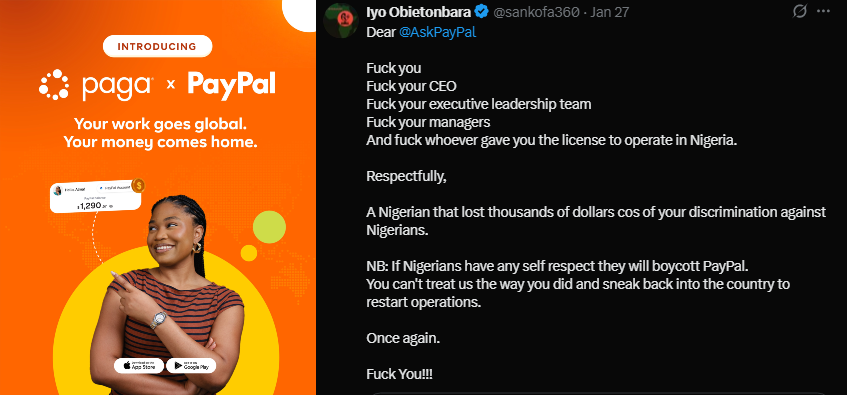
When PayPal announced its return to Nigeria last week through a partnership with local fintech Paga, the company probably expected celebration. Instead, Nigerians reacted with the middle finger.
“Dear @AskPayPal, F**k you. F**k your CEO. F**k your executive leadership team,” tweeted Iyo Obietonbara (@sankofa360), speaking for thousands of Nigerians who haven’t forgotten what PayPal did to them. “You can’t treat us the way you did and sneak back into the country to restart operations.”
The anger is not performative. It is personal. And it is deeply rooted in 20 years of frozen accounts, confiscated funds, and lost opportunities that PayPal left when it effectively banned Nigerians from receiving payments in the early 2000s.
The Wounds Are Still Fresh
TSMUSTY (@_tsmusty) decided to give PayPal another chance when the partnership was announced. He submitted the requested documents. PayPal banned him for life immediately. “F**K EM,” he wrote.
Another user, Mazi Nathan (@rukky_nate), recalls his aunt sending him $125 through PayPal in 2012. The money was reversed. She tried again with $68. PayPal seized it and permanently banned his account. “I no longer have screenshots of the email exchanges as proof,” he wrote, “but PayPal didn’t return to Nigeria after 21 years to solve any problem.” They came to test whether the Nigerian market could be foolish enough to help prop their failing business.”
The stories pile up. A user named Urhobo Territory (@Urhobo_territry) had €700 locked in 2018. PayPal told him to wait 180 days. “Until this day, I can’t access my account without explanation,” he wrote.
Simon Templar (@Simon_Lvar) knows someone with money still trapped in PayPal limbo, waiting for a response that will never come.
For Nigerian freelancers, remote workers, developers, and online entrepreneurs during the 2000s and 2010s, PayPal’s restrictions weren’t just inconvenient; they were economically crippling. While their counterparts in other countries could receive payments seamlessly, Nigerians were relegated to “send-only” status, watching international clients hesitate or abandon deals entirely because payment was too complicated.
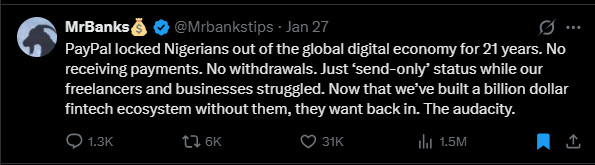
“PayPal locked Nigerians out of the global digital economy for 21 years,” wrote MrBanks (@Mrbankstips). “No receiving payments. No withdrawals. Just ‘send-only’ status while our freelancers and businesses struggled. Now that we’ve built a billion-dollar fintech ecosystem without them, they want back in. The audacity.”

The Fraud Excuse Never Made Sense
PayPal’s official reason for restricting Nigeria is fraud. The company claimed its monitoring systems detected cases of stolen credit cards used by individuals from blacklisted countries, pointing to Nigeria’s lack of robust identification systems and strict banking regulations.
The data seemed to support this. A 2009 academic paper found that the FBI and National White Collar Crime Centre ranked Nigeria as the third-highest perpetrator of cybercrime globally in 2007, remarkable considering less than 10% of Nigeria’s population had internet access at the time.
But here’s where the argument falls apart: The United States, where PayPal was founded, accounted for over 63% of cybercrime perpetrators. The UK, ranked second, accounted for 9.9%. Countries like India, Romania, and Brazil also had significant fraud activity. Yet PayPal never left those markets.
“If PayPal’s exit was truly about fraud alone, then the logic never held up,” explained one X user (@KharayKrayKray). “In dollar terms, countries like the United States, India, and Romania consistently account for far greater fraud losses than Nigeria ever has. The U.S. alone loses tens of billions of dollars to fraud every year, yet PayPal never left those markets.”
The math is simple: fraud is a cost of doing business everywhere. PayPal knows how to manage it. What Nigeria lacked wasn’t lower fraud; it lacked profitability at scale.
Adedeji Olowe, founder of Lendsqr and Paystack’s board chairman, puts it bluntly: “When you look at fraud versus total transactions, it starts to make sense. In one country, total transactions could be $10 million, and fraud accounts for $3 million. In another country, total transactions could be $10 billion, while fraud accounts for $100 million.”
Translation: PayPal didn’t leave because Nigeria was too risky. It left because Nigeria was not profitable enough to justify the risk management costs.
What Changed? Nigeria Built Without Them
Fast forward to 2025. Nigeria’s digital payments market hit ₦1.07 quadrillion ($754 billion) in 2024, up from ₦600 trillion the year before. The country now has a Bank Verification Number (BVN) system, a National Identification Number (NIN), and regulatory frameworks that didn’t exist two decades ago. Reported fraud cases fell from 124,000 in 2021 to fewer than 96,000 in 2023, even as transaction volumes exploded.
Nigeria was also removed from the Financial Action Task Force grey list in October 2025, further weakening the compliance argument global platforms had long used to justify exclusion.
But more importantly, Nigerians built alternatives. Paystack, Flutterwave, Grey, and a constellation of fintech startups emerged to fill the void PayPal left. These weren’t charity projects; they became billion-dollar companies serving the exact market PayPal had abandoned.
“PayPal is coming back to Nigeria, and there’s outrage from business owners, entrepreneurs and freelancers who want to boycott it,” wrote @KharayKrayKray. “Nigerians are angry because PayPal feels like that ex who left you when you had nothing and came back after you made something of yourself.”
The Optics Are Terrible
PayPal’s timing couldn’t look worse. The company has lost 75% of its stock value over the past five years. Its share price continues to decline. Multiple users on X pointed to this as evidence that PayPal isn’t returning to Nigeria out of goodwill; it’s returning out of desperation.
“PayPal has lost 75% of its share value in the last 5 years, and the decline is ongoing,” wrote Mazi Nathan. “They came to test whether the Nigerian market could be foolish enough to help prop their failing business.”
Even the partnership structure tells a story. PayPal isn’t operating directly in Nigeria; it’s piggybacking on Paga’s existing infrastructure and regulatory compliance. This is PayPal’s third attempt to re-enter Nigeria: it partnered with First Bank in 2014 (enabling only outbound payments) and with Flutterwave in 2021 (focused strictly on businesses). Both fizzled out.
Ossy Vincent (@ossynoya) summed it up: “PayPal coming into the Nigerian market is like 13-15 years too late, and they should honestly fuck off.” The amount of discrimination and withheld funds that NG freelancers have with those people without any valid explanation. But now they want to stroll in just like that, and Paga just gave them an in.”
Not Everyone Is Angry
To be fair, not all reactions were hostile. Dr Ndubuisi Ekekwe (@ndekekwe) offered a more optimistic take, arguing that PayPal’s return validates Nigeria’s progress.
“PayPal did not return because a delegation of politicians travelled to Silicon Valley to ‘invite’ it. No. It returned because Nigeria, especially the young people, built an ecosystem that made its absence too costly,” he wrote. “When the opportunity cost of staying away exceeded the risk of coming in, PayPal quietly joined the party.”
Ekekwe sees the return as proof that Nigeria’s fintech ecosystem has matured enough to attract global players. He acknowledges the disruption to local startups but frames it as the natural evolution of markets: “That is how global markets work. You build capacity, enforce standards, strengthen KYC, sanitize the rails, and one day the giants will notice.”
Adedeji Olowe shares a pragmatic view: “No one is operating at that level of ease PayPal allows.” If the service works, Nigerians will forget that they came and they left. MasterCard dominates cross-border card payments in Nigeria today; they also exited at some point, but they returned through Guaranty Trust Bank and UBA.”
Unyime Tommy, Managing Partner at Assurdly, believes adoption will be driven by performance, not sentiment. “Users always gravitate towards good service and good rates. If PayPal delivers on these, coupled with the fact that people still get paid globally via PayPal, returning shouldn’t be hard.”
The Bigger Picture
PayPal’s return to Nigeria, together with the backlash it has triggered, reveals something larger than one company’s business decisions. It exposes how global tech platforms have historically treated African markets: as afterthoughts, acceptable losses, and last-priority opportunities.
When fraud was a convenient excuse, Nigeria was blacklisted. When profitability became attractive, the fraud concerns evaporated. The infrastructure improvements Nigeria made, BVN, NIN, and stronger KYC regulations, were necessary, but they weren’t sufficient to bring PayPal back. What brought PayPal back was a trillion-naira market it could no longer afford to ignore.
This issue is not just about PayPal. It’s about every platform, every service, and every company that excludes African markets when it’s convenient and returns when it’s profitable, expecting gratitude instead of accountability.
Nigerians built billion-dollar fintech companies in PayPal’s absence. They didn’t do it to compete with PayPal; they did it because PayPal left them no choice. Now, PayPal wants access to the infrastructure, the regulatory environment, and the market that Nigerians built without them.
The question is not whether PayPal will succeed in Nigeria. The question is whether African markets will continue to accept companies that show up after the hard work is done. And based on the reactions so far, the answer is becoming clear: not without a fight.