
It Doesn’t Make Sense Fighting for a Stadium When One Can Own the Community A Philosophical Treatise on Discovering One’s Niche, Majoring in What Matters, and Turning Obstacles into Uncommon Opportunities
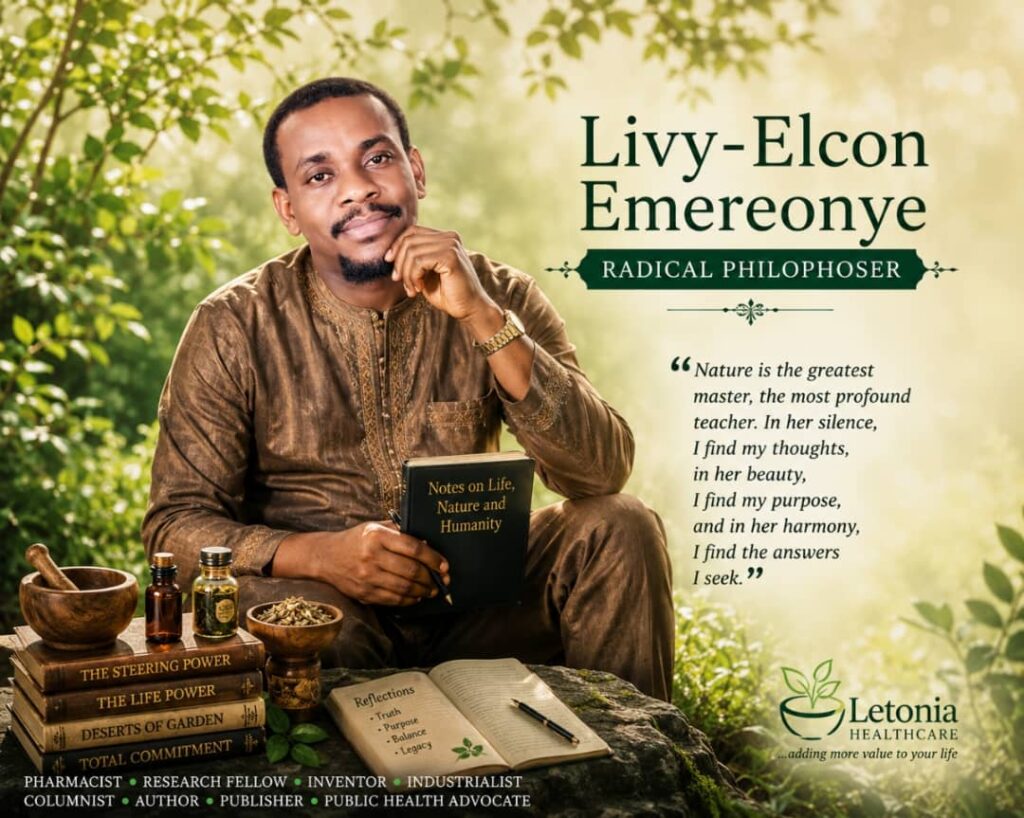
By Livy-Elcon Emereonye
There is an irony that has quietly settled over human civilization like the evening mist over an ancient valley. It is the irony of people who spend the greater part of their lives wrestling over keys while ignoring the opportunity to build the entire house. They quarrel over seats while neglecting the wisdom of manufacturing chairs. They exhaust themselves competing for borrowed influence when destiny has already placed within them the raw materials for creating enduring relevance.
Indeed, it doesn’t make sense fighting for a stadium when one can own the community.
The statement sounds mischievous. It provokes a smile before it provokes a thought. Like many timeless proverbs, it arrives dressed in simplicity but carries within it the weight of generations of wisdom. It is satire with a surgical blade. It laughs at our misplaced ambitions while exposing one of the greatest philosophical errors of mankind—the tendency to confuse visibility with value, position with purpose, and applause with accomplishment.
Modern society has perfected the art of celebrating the occupant of the stage while forgetting the architect who designed the theatre. We applaud the footballer who scores the winning goal, yet scarcely remember the entrepreneur who built the stadium, the engineer who designed it, the scientist whose innovations made the floodlights possible, or the farmer whose harvest fed both spectators and players. The crowd naturally looks upward toward the performer, while history quietly bows before the creator.
The tragedy of many lives is not the absence of talent. It is the misdirection of talent. Rivers do not become oceans because they possess more water than every stream; they become oceans because they know where they are going. Direction is often more powerful than speed. A man running in the wrong direction only arrives at irrelevance faster.
How many gifted people spend decades fighting battles they were never designed to fight? How many brilliant minds waste priceless years chasing titles whose glamour evaporates with the ink of a retirement letter? How many extraordinary individuals become ordinary because they measure success by another person’s tape?
Nature has always preached a sermon that humanity seldom listens to. The eagle never apologizes because it cannot swim like the dolphin. The whale does not envy the antelope because it cannot outrun it. The palm tree never competes with the bamboo over height, nor does the sunflower envy the rose because their seasons of beauty differ. Every creature understands its ecological assignment—except man, who often mistakes imitation for ambition.
There is something profoundly comical about watching a fish campaigning to become the king of birds. Equally absurd is watching an eagle lament that it cannot breathe underwater. Yet this is precisely what many educated people do every day. They abandon the territories where excellence awaits them and invade arenas where mediocrity is guaranteed.
The marketplace has become crowded not because there are too many gifted people, but because too many gifted people are selling the same commodity. Originality has become endangered, while imitation has become fashionable. Entire generations now queue at the same narrow gate, pushing and shoving one another for opportunities that were never meant to accommodate everyone.
Meanwhile, unexplored frontiers lie quietly waiting for pioneers.
History has always rewarded pioneers more generously than competitors.
Christopher Columbus did not become famous because he sailed better than everyone else. He became memorable because he sailed where others feared to venture. Thomas Edison did not merely improve darkness; he challenged its permanence. The Wright brothers refused to believe that gravity possessed the final vote over human destiny. Every significant advancement in civilization began when someone abandoned the crowded road and created another.
That is the invisible power of discovering one’s niche.
Your niche is not merely what you are trained to do. It is the sacred intersection where your gifts, your convictions, your experiences, your burdens, your passions, and humanity’s needs converge. It is the address where your usefulness resides. It is the geographical location of your destiny.
Many people search for success while success patiently waits inside their purpose.
A mango seed never becomes an iroko tree, not because it lacks life, but because life has already defined its assignment. Every seed carries within itself an invisible blueprint. Likewise, every human being arrives on earth carrying a unique architecture of possibility. The tragedy is that many die as photocopies of others instead of becoming the original manuscripts they were born to be.
One of the most expensive mistakes in life is spending your strength improving a weakness while neglecting the gift that could have transformed generations. There is wisdom in development, but there is greater wisdom in specialization. Society remembers those who solved problems, not those who merely participated in activities.
A man may know a little about everything and still become unforgettable for mastering one thing.
Gold is valuable because it is scarce.
Diamonds command attention because they are rare.
Excellence derives its market value from focused refinement.
The temptation to become everything to everybody has produced countless nobodies. A candle that tries to illuminate the whole city ends up extinguishing itself. Even the sun, magnificent as it is, shines from one position while lighting the entire earth. Influence does not require restlessness; it requires consistency.
Life repeatedly teaches this lesson through ordinary experiences.
Visit any marketplace.
One trader sells vegetables.
Another repairs shoes.
A third specializes in mobile phones.
A fourth bakes bread.
Each prospers, not by selling everything, but by becoming known for something.
Ironically, the customer who wants everything from one shop often leaves disappointed. Trust grows where specialization lives.
The same principle governs leadership, scholarship, entrepreneurship, and nation-building.
Nations rise because individuals discover their comparative advantages. Japan mastered precision. Switzerland became synonymous with quality. Silicon Valley cultivated innovation. Every enduring civilization identified its strengths and multiplied them instead of dissipating energy chasing every passing fashion.
Individuals are governed by the same law.
The lawyer who understands negotiation creates influence beyond the courtroom.
The physician who dedicates himself to research changes medicine for generations.
The teacher who ignites curiosity lives forever in the achievements of former students.
The pharmacist who refuses to remain behind the dispensing counter and instead pioneers new frontiers in pharmaceutical innovation creates an ecosystem where others merely sought employment.
The difference between significance and survival often lies in recognizing where one can create value rather than where one can merely occupy space.
And here lies the hidden satire of our age.
Too many people are fighting over the microphone while ignoring the ownership of the broadcasting station.
They celebrate the ribbon-cutting ceremony but overlook the years of planning that made the ceremony possible.
They envy crowns without understanding the burdens that forged the king.
The loudest applause is usually reserved for the visible performer, but the deepest gratitude belongs to the invisible builder.
Life quietly whispers a timeless truth to those willing to listen:
Do not merely ask where the crowd is gathering.
Ask where the future is waiting to be built.
For there comes a point when the wise cease struggling for admission into someone else’s stadium and begin laying the foundations of an entire community.
And that is where true greatness begins.
The Alchemy of Obstacles and the Majesty of Purpose
Every generation inherits two marketplaces.
The first is noisy.
The second is silent.
The noisy marketplace is crowded with competitors. It is filled with elbows, accusations, desperate ambitions, political intrigues, unnecessary rivalries and endless comparisons. Everybody wants the same office, the same title, the same recognition and the same applause. Here, success is measured by how many people one defeats.
The silent marketplace is different.
There, inventors are thinking.
Researchers are experimenting.
Entrepreneurs are building.
Teachers are moulding.
Farmers are cultivating.
Scientists are discovering.
Philosophers are questioning.
Visionaries are creating tomorrow while the crowd argues about yesterday.
Ironically, history has always promoted those who chose the silent marketplace.
While Rome was entertaining itself in magnificent arenas, unknown engineers were quietly building aqueducts that sustained civilizations. While kings fought over territories, blacksmiths forged the weapons, carpenters built the ships, and anonymous craftsmen erected monuments that outlived their patrons. Time possesses an unusual sense of humour. It often immortalizes the builder while quietly forgetting the quarrels of those who fought over temporary privileges.
Life itself is a relentless teacher of this philosophy.
Observe the village blacksmith.
His workshop is never as glamorous as the chief’s palace. His hands are stained with soot, his clothes smell of iron, and his face bears the marks of honest labour. Yet when the farmer needs a cutlass, the hunter requires a trap, or the warrior demands a spear, they all return to the blacksmith.
The palace may command authority.
The workshop commands necessity.
And necessity has always outlived ceremony.
One of the greatest illusions of our age is the belief that visibility automatically translates into significance. Social media has magnified this deception. We count followers but ignore substance. We celebrate trends but neglect transformation. We admire those who occupy the front page while overlooking those quietly writing the future.
A tree never advertises its roots.
Yet every branch depends upon them.
The deepest contributions to humanity are often hidden beneath the surface.
The seed disappears before the harvest appears.
The foundation is buried before the skyscraper rises.
The womb remains unseen before the child is celebrated.
Invisible labour has always been the mother of visible greatness.
This is why obstacles should never be interpreted merely as inconveniences.
More often than not, they are invitations.
Every locked door silently asks whether you possess the creativity to design another entrance.
Every rejection asks whether your confidence depends upon human approval.
Every disappointment asks whether your dream belongs to the crowd or to your conviction.
Life has a curious habit of disguising opportunities as adversity. Unfortunately, most people judge the package before opening it.
When a sculptor looks at a rough stone, he does not see a rock. He sees a statue imprisoned within granite. Every strike of the chisel appears destructive to the casual observer, yet each blow is an act of liberation. The sculpture is not manufactured; it is revealed.
So it is with human destiny.
Adversity does not always destroy greatness.
Very often, it uncovers it.
History bears eloquent testimony.
The automobile emerged because humanity refused to remain dependent on horses.
Modern aviation was born because two bicycle mechanics dared to believe that gravity could be negotiated.
Countless life-saving medicines exist today because researchers refused to surrender to diseases that once appeared unconquerable.
Progress has always been the child of dissatisfaction.
Comfort has never produced civilization.
There is another lesson hidden within nature.
Consider the oyster.
The pearl it eventually produces begins as an irritation. A tiny grain of sand enters its shell and causes persistent discomfort. Instead of surrendering to irritation, the oyster transforms the nuisance into beauty. Layer upon layer, it coats the offending particle until the source of pain becomes an object of priceless value.
Human greatness follows the same pattern.
Some of the world’s finest institutions were born out of frustration.
Many revolutionary businesses emerged from personal inconvenience.
Remarkable inventions began as someone’s refusal to accept the status quo.
Sometimes your greatest opportunity arrives disguised as your greatest annoyance.
The obstacle is not your enemy.
Your interpretation of the obstacle may be.
This explains why two individuals can encounter the same difficulty and arrive at completely different destinations.
One complains.
The other creates.
One curses the darkness.
The other manufactures lanterns.
One sees unemployment.
Another establishes an industry that employs thousands.
One laments the collapse of a system.
Another builds a better one.
The difference rarely lies in circumstances.
It lies in perspective.
Perspective is the architect of destiny.
The farmer and the poet both look at the rain.
The farmer sees harvest.
The poet sees inspiration.
The engineer sees hydroelectric power.
The child sees puddles to play in.
Reality has not changed.
Only perception has.
This is why philosophy matters.
It teaches us not merely how to think, but what to notice.
And what we consistently notice eventually determines what we become.
Sadly, our educational systems have often rewarded conformity more than creativity. Students are trained to answer existing questions instead of discovering new ones. We produce excellent examinees but too few explorers. We celebrate certificates while neglecting curiosity. Yet civilization advances not because people memorize answers, but because someone dares to ask a question nobody else considered.
The greatest minds have always been unusually curious.
Isaac Newton did not invent gravity; he questioned what everyone else ignored.
Alexander Fleming did not plan to discover penicillin; he noticed what others would have discarded.
Innovation often begins where ordinary observation ends.
That is why every obstacle deserves careful examination.
Hidden inside every challenge is an unanswered question.
Whoever answers it first owns the opportunity.
The entrepreneur who solves traffic creates transportation systems.
The scientist who solves disease transforms healthcare.
The educator who solves ignorance shapes civilizations.
The communicator who solves misunderstanding builds peace.
The statesman who solves division writes history.
The niche you seek is frequently concealed within the problem that refuses to leave your heart.
Many spend years praying for opportunities while quietly walking past them every morning because opportunities rarely announce themselves with trumpets. They often arrive wearing the dusty clothes of hard work, uncertainty and inconvenience.
The miner does not complain that diamonds are hidden beneath the earth.
He understands that precious things are rarely found on the surface.
Likewise, extraordinary opportunities seldom reside in places where everyone is already comfortable.
This truth explains why genuine pioneers often appear eccentric before they become celebrated. Society initially laughs at unconventional ideas because familiarity is more comfortable than possibility. Yesterday’s impossibility often becomes tomorrow’s normality.
There was a time when speaking across continents without wires sounded absurd. There was a time when carrying a library in one’s pocket belonged to the realm of fantasy. There was a time when surgery assisted by robots would have been dismissed as fiction.
Yet every modern convenience was once an unpopular idea protected by one determined mind.
That determined mind had discovered its community instead of competing for a stadium.
And therein lies the profound satire of life.
Many are exhausting themselves polishing the brass handle of a rented office, while others are quietly purchasing the entire building.
Some spend decades lobbying to become gatekeepers.
Others become city builders.
One group negotiates access.
The other creates access.
One fights over influence.
The other manufactures influence.
As the years unfold, history invariably reveals the difference.
For the world eventually bows—not before those who merely occupied positions—but before those who transformed problems into possibilities and opportunities into enduring legacies.
The Architecture of Legacy
There comes a defining moment in every life when the questions change.
In youth, we ask, “How do I get in?”
As maturity dawns, we begin to ask, “How do I stand out?”
But wisdom asks an entirely different question:
“How do I make this place better because I passed through it?”
That is the question that separates ambition from legacy.
Ambition seeks a position.
Legacy creates a platform.
Ambition counts followers.
Legacy raises leaders.
Ambition asks for recognition.
Legacy becomes indispensable.
The world has never been transformed merely by people who occupied offices. It has been transformed by men and women who occupied purpose. Offices are furnished with tables, chairs and plaques; purpose is furnished with vision, sacrifice and conviction. When the office expires, purpose continues its journey through the lives it has touched.
Consider the village well.
Nobody celebrates the mason who dug it every morning, yet generations draw water from his labour. Children who never knew his name drink because he thought beyond his own lifetime. Such is the quiet dignity of those who build communities instead of merely decorating stadiums.
Our age is fascinated by the spectacular. We admire the cutting of ribbons but seldom appreciate the years of planning, setbacks, redesigns and perseverance that made the ceremony possible. We applaud the fruit while forgetting the patient roots that wrestled silently beneath the soil. Yet the laws of life remain unchanged: every visible harvest is the public announcement of an invisible discipline.
The bamboo offers another lesson. For years it appears to do almost nothing above the ground. To the impatient observer, it seems unproductive. But beneath the surface it is weaving an intricate network of roots. Then, in what appears to be a sudden miracle, it shoots upward with astonishing speed. The miracle was never sudden. It had been preparing in silence.
So it is with purpose.
The years spent mastering a craft are never wasted.
The nights devoted to study are never lost.
The failures that refine judgment are never meaningless.
The disappointments that strengthen character are never accidental.
They are roots.
And roots do not compete with branches.
They sustain them.
This is why one must never despise seasons of obscurity. The world often mistakes silence for stagnation, but many destinies are being assembled behind curtains that applause cannot penetrate. A seed buried in the earth is not attending its funeral; it is preparing for its resurrection.
There is also a profound lesson in the carpenter’s workshop. Before a magnificent piece of furniture emerges, the wood must first submit to the saw, the plane, the chisel and the sandpaper. Every tool appears hostile until the masterpiece is complete. Likewise, life’s rough edges often become the instruments that polish extraordinary people.
The obstacle you resent today may become the testimony that defines you tomorrow.
The rejection that redirected your path may prove to be the greatest favour life ever granted you.
The closed door may have prevented you from entering a room too small for your destiny.
How often have we mourned opportunities that would have imprisoned our potential had they materialized? Providence sometimes says “no” because it is preparing a greater “yes.” A wise traveller does not curse every detour; some roads are closed to prevent disaster, while others are opened to reveal a better destination.
The same principle applies to nations.
A country prospers not when every citizen seeks political office, but when every citizen discovers how to create value. A nation cannot survive on speeches alone. It needs inventors to innovate, farmers to cultivate, teachers to educate, healthcare professionals to heal, entrepreneurs to create wealth, artists to inspire, engineers to build, and thinkers to illuminate the path ahead.
Civilizations flourish when people major in what truly matters.
The orchestra becomes beautiful not because every musician plays the same instrument, but because each one masters a different instrument while following the same score. Uniformity produces noise; harmony produces music.
How tragic, then, when gifted individuals abandon their instruments simply because another section of the orchestra seems more glamorous. The violin envies the trumpet. The trumpet imitates the drum. The drum competes with the flute. In the end, everyone loses the symphony.
Purpose is not discovered by comparison.
It is discovered by conviction.
One of the greatest freedoms in life is the freedom to stop competing with everyone. The day you discover your niche, envy begins to lose its grip. Comparison becomes unnecessary. You cease measuring your worth by another person’s achievements because you are no longer running another person’s race. You become a builder, not a spectator; an architect, not merely an occupant.
And this is where obstacles assume an entirely different meaning.
The wall that stopped others becomes the foundation upon which you build.
The stone that caused others to stumble becomes the cornerstone of your enterprise.
The storm that uprooted weaker trees deepens your own roots.
The desert that frightened the faint-hearted teaches you where hidden wells can be found.
Life has an unusual habit of rewarding those who ask better questions. Instead of asking, “Why is this happening to me?” they ask, “What is this preparing me for?” Instead of asking, “Who closed the door?” they ask, “What door can I build?” Instead of asking, “Who will give me permission?” they ask, “What value can I create that makes permission irrelevant?”
These are the questions of community builders.
They are the questions of pioneers.
They are the questions that shape history.
When all is said and done, life will not merely examine the positions we occupied; it will examine the problems we solved. It will not ask how loudly we were applauded, but how deeply we served. It will not measure the number of stadiums in which we stood beneath the floodlights; it will measure the number of communities that became brighter because we chose to light a lamp instead of cursing the darkness.
And so, dear reader, before you expend another ounce of energy fighting over a seat, pause for a moment and look beyond the arena. Beyond the cheers lies the neighbourhood. Beyond the stadium lies the community. Beyond the title lies the legacy.
Perhaps your greatest calling is not to become the loudest voice in an existing conversation, but to begin a conversation that generations after you will still be having.
For the truly wise do not spend their lives struggling to become indispensable to an institution.
They build institutions that become indispensable to society.
They do not merely inherit platforms.
They create ecosystems.
They do not merely occupy history.
They author it.
And when the final chapter of their lives is written, the verdict is unmistakable: they understood that it never made sense to spend a lifetime fighting for a stadium when they possessed the vision, the courage, and the uncommon discipline to own the community.
PS: Dr. Emereonye could be reached on: +234 803 3922 445