CAN THE FEDERAL GOVERNMENT BUILD A SEAPORT IN NORTHERN NIGERIA?
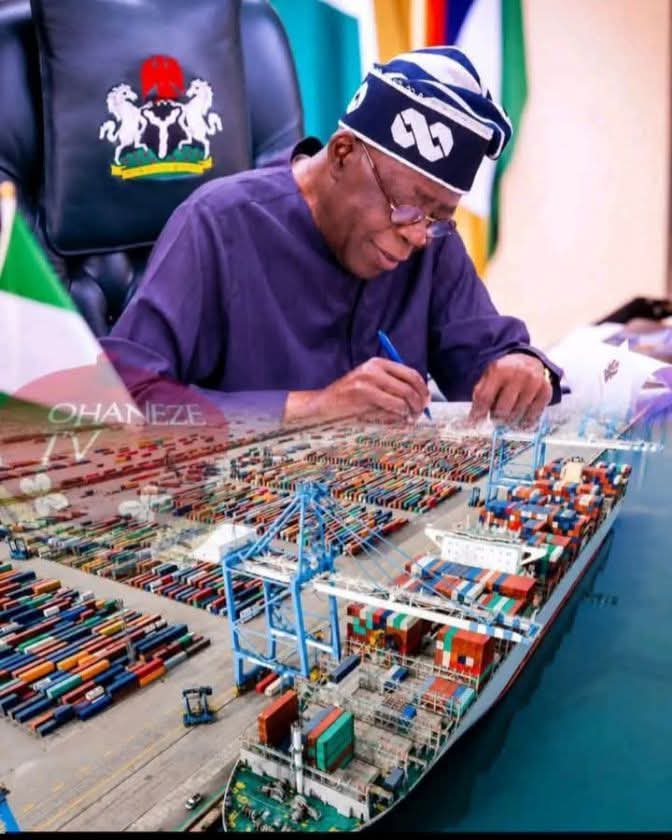
Every election season, some politicians promise “Northern Seaport,” “River Niger Seaport,” or “Benue Inland Port” as if you can simply pour sand and build an ocean.
But geography does not obey politics.
And now some Arewa people who don’t understand these things are beginning to say “Tinubu doesn’t want to build a Port in the North”.
But a real Seaport is not just water.
It is DEPTH, TIDE, ACCESS TO OCEAN ROUTES, NATURAL DRAFT, AND CONSTANT YEAR-ROUND NAVIGATION.
Did you read that?
Read it again.
That is why countries spend BILLIONS trying to create what nature already gave places like Lagos, Rotterdam, Singapore, Shanghai, and Dubai.
Nigeria’s major seaports exist near the Atlantic Ocean for a reason:
Apapa Port — established in 1921.
Tin Can Island Port — 1977.
Onne Port — Rivers State.
Lekki Deep Sea Port — commissioned 2023.
Why there?
Because the ocean is there.
Now let’s face the controversial question.
CAN THE INTERSECTION OF RIVER NIGER AND RIVER BENUE BE DREDGED INTO A SEAPORT?
Short answer: NO.
Not a true international seaport.
And here are the reasons many people avoid discussing openly.
- RIVERS ARE NOT OCEANS
The River Niger and the River Benue are inland freshwater rivers.
Large container ships need a deep natural draft.
Modern cargo ships today require:
14 to 18 meters in depth.
Massive turning basins.
Stable tidal movement.
Constant year-round water levels.
Most parts of the River Niger fluctuate heavily between rainy and dry seasons.
During the dry season, many sections become too shallow even for medium vessels.
You cannot compare that to the Atlantic Ocean.
- DREDGING IS NOT MAGIC
Many Nigerians think dredging means “dig once and ships will come forever.”
Wrong.
The River Niger carries enormous sediments yearly from the Guinea Highlands through Mali, the Niger Republic, and Nigeria.
That means:
Sand returns constantly.
Channels close repeatedly.
Maintenance becomes endless.
Egypt spends billions maintaining the Suez Canal.
The United States spends heavily on maintaining the Mississippi shipping system.
Now imagine Nigeria trying to maintain over 1,000km of unstable inland river channel every year just to force giant ocean vessels into Northern Nigeria.
The economy would collapse.
- BRIDGES WOULD BECOME A DISASTER.
Look at how many bridges cross the River Niger and Benue:
- Onitsha Bridge
- Second Niger Bridge
- Lokoja Bridge
- Jebba Bridge
- Makurdi Bridge
Large international cargo ships are extremely tall.
Many existing bridges were never designed for massive ocean-going vessels.
To make such shipping possible, Nigeria would need to:
- demolish bridges,
- rebuild higher mega-bridges,
- Redesign entire transport systems.
That would cost tens of BILLIONS of dollars.
- PORTS REQUIRE TIDAL ADVANTAGE.
Real seaports benefit from ocean tides that naturally assist navigation and flushing.
Inland rivers lack this advantage.
This is one reason why even rich countries rarely build true seaports deep inland unless connected naturally to oceans through very stable channels.
HISTORY ALREADY PROVED THIS
The British colonial government studied the River Niger extensively from the late 1800s.
Even after decades of surveys, they still concentrated major ports near the coast:
Lagos
Port Harcourt
Warri
Why?
Because geography defeated politics.
Even Lokoja — where Niger and Benue meet — became important as a trading post, NOT as a global seaport.
WHAT NORTHERN NIGERIA ACTUALLY NEEDS IS DIFFERENT
Instead of chasing “ocean seaport dreams,” Northern Nigeria can become:
- Africa’s logistics capital.
- Dry port hub
- Rail transport giant
- Agro-processing powerhouse
Countries like Kazakhstan and Ethiopia are landlocked yet still built strong economies through:
Rail systems,
Inland container depots,
Industrial zones,
Aviation logistics.
Kaduna Inland Dry Port was commissioned in 2018 for this reason.
A DRY PORT makes more economic sense than forcing Atlantic Ocean ships into Lokoja.
Truth is, you can dredge rivers for better inland transport.
You can improve barge movement.
You can create river ports.
But turning the Rivers Niger and Benue into a true global deep-seaport system for giant ocean vessels is economically, geographically, and technically unrealistic.
Nature gave coastal states the ocean advantage.
The smarter strategy is not to fight geography… but to build wealth around it.
Ugoji Maximillian Teacher of systems. Translator of power. Builder of an elite mindset. Speaker, Author, and Entrepreneur.