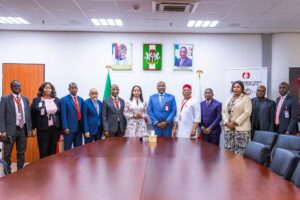
Courts Lack Power To Choose APC Candidate — Northern, Eastern Lawyers

By Felix Oti, Awka
The Coalition of Northern and Eastern Nigeria Lawyers Network has restated that the nomination and sponsorship of candidates for elective offices remains the exclusive internal affair of political parties, a principle firmly entrenched in Nigerian jurisprudence.
In a statement jointly signed by its Spokespersons, Hon. Chinasa Igboke Nworu, Esq. and Abubakar Sani Musa, Esq., the Coalition emphasised that courts lack the general jurisdiction to determine who a political party should sponsor as its candidate.
“The nomination and sponsorship of a candidate for an election is a political question and a domestic affair of the political party concerned. It is governed by the party’s constitution, guidelines and internal processes. No court has the power to substitute its own preference for that of the party,” the Spokespersons stated.
The Coalition specifically addressed the situation in Imo West Senatorial District, where the All Progressives Congress (APC) has nominated and sponsored Senator Hope Uzodimma as its candidate while the Federal High Court recognised Rochas Okorocha.
According to the Spokespersons, once a political party has validly nominated and sponsored its candidate in accordance with its constitution and the Electoral Act, no court has the power to impose another aspirant on the party.
“In the Imo West Senatorial District, the APC nominated and sponsored Senator Hope Uzodimma. That decision is an internal affair of the party. The court cannot impose another candidate on the APC in place of the candidate the party has chosen and sponsored. To do so would be a direct interference in the domestic affairs of the political party, contrary to well-settled Supreme Court authorities,” the Coalition stated.
The Coalition anchored its position on a long line of authoritative decisions of the Supreme Court of Nigeria.
The foundational authority remains Onuoha v. Okafor (1983) 2 SCNLR 244. In that landmark case, the Supreme Court held that the issue of who should be a candidate of a given political party at any election is clearly a political one, to be determined by the rules and constitution of the party. It is a domestic issue and not justiciable in a court of law. The Court stressed that the right to nominate and sponsor a candidate is vested in the political party, and the exercise of that right is its internal affair.
This principle was emphatically reaffirmed in Dalhatu v. Turaki (2003) 15 NWLR (Pt. 843) 310. The Supreme Court, per Katsina-Alu, JSC (as he then was), restated that the power and right to nominate and sponsor a candidate for election are vested in a political party and constitute its domestic affair. The Court made it clear that a member of a political party has no enforceable legal right to be sponsored by the party, and courts cannot compel a party to nominate a particular aspirant.
Subsequent decisions have consistently maintained this position. In Magaji v. APC (2024) 1 NWLR (Pt. 1918) 1, the Supreme Court again described a political party as akin to a club with its own rules, regulations, guidelines and constitution. The Court held that the internal affairs of a political party are not justiciable except where the Constitution or a statute expressly confers jurisdiction, or where the dispute involves the commission of a crime, breach of contract or tort. Nomination and sponsorship of candidates were expressly characterised as non-justiciable political questions falling within the exclusive domain of the party.
The Coalition noted that while Section 84(14) of the Electoral Act (and the corresponding provision under Section 285(14) of the 1999 Constitution) creates a limited right of action for an aspirant who actually participated in a party primary to complain that the provisions of the Electoral Act or the party’s own guidelines were not complied with, this remains a narrow exception. It does not convert the general right of a political party to choose its candidate into a justiciable right open to every aggrieved member or outsider, nor does it empower the court to impose a different candidate on the party after the party has already nominated and sponsored its preferred candidate.
“The courts have repeatedly warned against turning every intra-party disagreement over nomination into a justiciable dispute. The principle in Onuoha and Dalhatu remains good law. Courts must resist the temptation to interfere in pure internal party decisions on candidate selection. In the specific case of Imo West, where the APC has already nominated and sponsored Senator Hope Uzodimma, the court cannot lawfully impose another candidate on the party,” the Spokespersons added.
The Coalition further observed that membership of a political party, leadership contests within the party, and the ultimate choice of who the party presents to the electorate are matters the Supreme Court has consistently treated as non-justiciable domestic affairs (see also Ardo v. Nyako (2014) 10 NWLR (Pt. 1416) 591 and more recent decisions reaffirming the same principle).
The Coalition urged the Court of Appeal to upturn the decision of the Federal High Court to continue to exercise restraint and to respect the constitutional and statutory boundaries that protect the autonomy of political parties in the nomination process. It maintained that any expansion of judicial intervention beyond the clear statutory exceptions risks undermining the voluntary character of political parties and the democratic right of parties to determine their standard-bearers.
“The supremacy of the Constitution and the rule of law require that the internal processes of political parties be respected, subject only to the limited exceptions expressly created by law. Nomination of candidates is, and remains, the internal affair of the political party. In Imo West Senatorial District, the APC having nominated and sponsored Senator Hope Uzodimma, no court can impose another candidate on the party,” the Spokespersons concluded.