
Data Centres: All to Know About the Buildings that Run the Internet
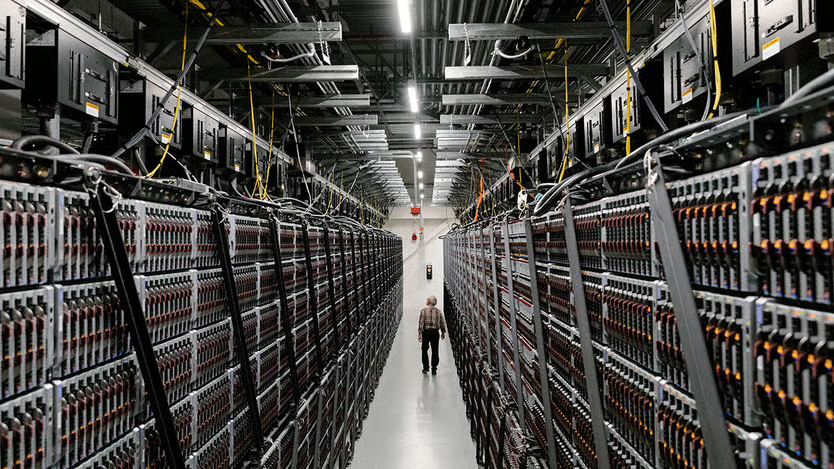
Photo Credit: The economist
By Epiphanus Obia
Every time you send money on OPay, stream a video on YouTube, or check your bank balance on an app, that action travels somewhere physical. It doesn’t just float in “the cloud”. It lands in a building, a very specific, very deliberate kind of building, called a data centre.
Think of a data centre as a warehouse for computers. Not the laptop on your desk, but thousands of powerful servers stacked floor to ceiling, humming around the clock, storing information and processing requests from millions of users simultaneously. These buildings are kept cool by industrial-grade air systems, protected by layers of physical and digital security, and connected to the internet through thick underground cables. They are, in every practical sense, the physical backbone of the digital world.
A Few Terms Worth Knowing
When people talk about data centres, a handful of words come up repeatedly. Colocation means a company rents space inside someone else’s data centre rather than building its own, which is cheaper, faster, and more flexible. Hyperscale refers to the giant facilities operated by companies like Google, Microsoft, and Amazon, capable of handling millions of requests per second. Latency is the time it takes for data to travel from a server to your device; the closer the server, the lower the latency, and the faster your app feels. And uptime is the percentage of time a facility stays operational; serious data centres target 99.999%, which works out to less than six minutes of downtime per year.
Where Nigeria Stands Right Now
According to Business Wire, Nigeria currently hosts around 20 colocation data centres, with 80% concentrated in Lagos, in areas like Yaba, Ikeja, and Victoria Island. That footprint is small relative to the country’s digital appetite, but the investment coming in tells a different story.
In November 2025, Equinix announced a $22 million investment to develop its LG3 data centre in Lagos, the first phase of a wider $100 million Africa expansion plan. MTN Nigeria unveiled the Dabengwa Data Centre in Ikeja, a $150 million first-phase project and West Africa’s largest prefabricated modular data facility, featuring over 1,500 server racks and AI-powered cooling. The market itself is projected to grow from roughly $288 million in 2025 to over $1 billion by 2031.
What’s pulling this investment in? Three things mainly. Nigeria has 179.64 million mobile subscribers. Google’s Equiano and Meta’s 2Africa submarine cables now land on Nigerian shores, delivering roughly twenty times the bandwidth of older systems and dramatically cutting the cost of moving data. And Nigeria’s fintech ecosystem, one of the most active on the continent, generates enormous data that regulators increasingly require to be stored locally.
The obstacle everyone talks about is power. Nigeria has an installed generation capacity of 13,625 MW, but only around 5,200 MW is typically available. Data centres need reliable, uninterrupted electricity. Without it, operators run on diesel generators, which are expensive and polluting and put a ceiling on how big any facility can realistically grow.
The Bigger Picture: Africa’s Data Race
South Africa currently leads the continent, with over 50 operational data centres and a $2.7 billion investment pipeline. Its government recently declared data centres essential infrastructure, on par with ports and electricity, and is exploring tax breaks and faster regulatory approvals to cement its position as Africa’s digital hub.
Nigeria is the clear second, but the gap matters. When a bank in Lagos uses a cloud service hosted in Johannesburg or Europe, every millisecond of extra distance costs money and slows the experience. Building more local infrastructure is not just a tech story; it’s an economic one. Data centres attract fintechs, AI startups, and multinational tech companies. They create jobs. They keep data sovereign, meaning sensitive financial and health records stay within the country’s borders rather than being governed by foreign laws.
The continent as a whole is expected to more than double its data centre capacity over the next five years, driven by a young population, rising smartphone penetration, and the growth of AI workloads that require enormous computing power close to where users live.
Nigeria has the population, the startup ecosystem, the cable connectivity, and now the investment momentum. The remaining equation is infrastructure, power, policy, and the political will to treat digital infrastructure the way South Africa just declared it should be treated: as essential as a road.
The buildings that run the internet are going up across Lagos and Nigeria. The question now is how fast and whether the lights can stay on long enough to keep them running.