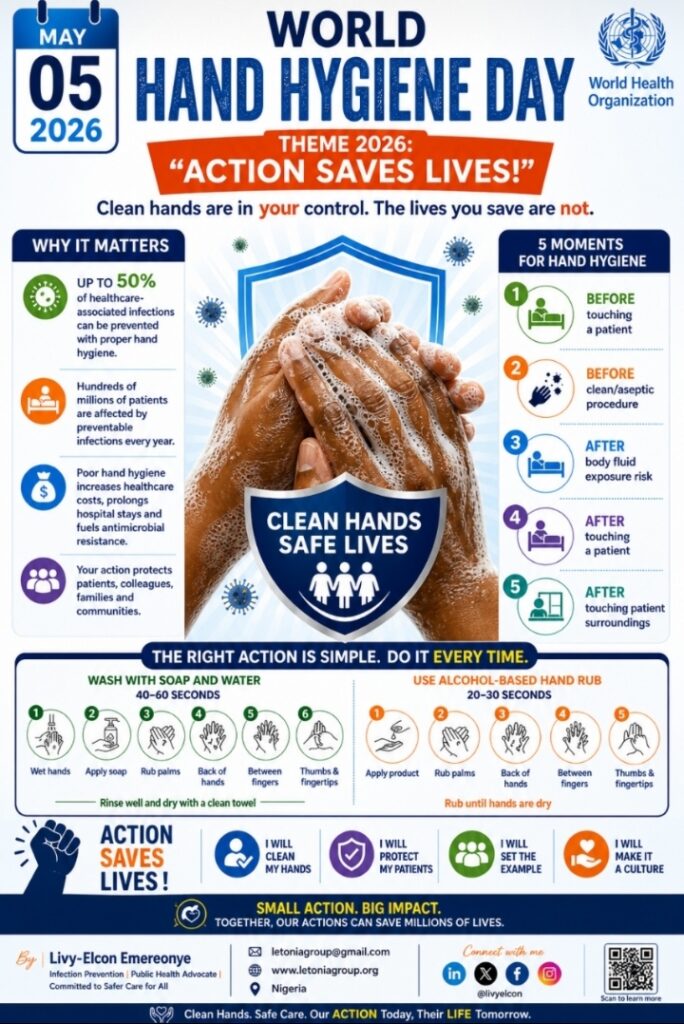
World Hand Hygiene Day 2026: Action Saves Lives!A Polemical, Scientific, and Philosophical Reflection
By Livy-Elcon Emereonye
Every year on May 5, the world pauses—at least symbolically—to acknowledge one of the simplest yet most powerful acts in medicine and public health: hand hygiene. The 2026 theme, “Action saves lives!”, is not merely a slogan; it is a rebuke, a challenge, and a call to conscience. It forces us to confront an uncomfortable truth: what kills millions globally is often not ignorance of what to do, but failure to act on what is already known.
Hand hygiene sits at the intersection of science, ethics, and human behavior. It is a domain where knowledge is abundant, evidence is overwhelming, and yet compliance remains disturbingly inadequate. That contradiction is not accidental—it reflects deeper failures in systems, attitudes, and priorities.
This article argues that hand hygiene is not just a clinical protocol but a moral imperative, a philosophical test of responsibility, and a scientific cornerstone of disease prevention. If action saves lives, then inaction, negligence, and indifference cost them.
The Scientific Certainty: Germ Theory Is Not Optional
Let us begin with what is not debatable.
Since the pioneering work of Ignaz Semmelweis in the 19th century, the scientific community has established beyond doubt that pathogens—bacteria, viruses, fungi—are transmitted through contact, particularly via the hands of healthcare workers and individuals in communal environments. Modern microbiology has only strengthened this understanding.
The World Health Organization (WHO) estimates that hundreds of millions of patients are affected by healthcare-associated infections (HAIs) annually. A significant proportion of these infections are preventable through proper hand hygiene. In low- and middle-income countries, including Nigeria, the burden is even higher due to systemic challenges such as overcrowding, inadequate infrastructure, and inconsistent compliance.
Hand hygiene, whether through washing with soap and water or the use of alcohol-based hand rubs, has been shown to reduce infection rates dramatically. Studies consistently demonstrate reductions in HAIs by up to 50% when proper protocols are followed.
So, the science is settled. The evidence is overwhelming. The tools are available.
And yet, people still die from preventable infections by contact-transmitted diseases.
Why?
The Paradox of Knowledge Without Action
The greatest tragedy in modern healthcare is not lack of knowledge—it is the failure to translate knowledge into consistent action.
Healthcare workers are trained. Protocols are displayed on walls. Campaigns are launched. Yet compliance rates in many settings hover between 30% and 60%. In some environments, it is even lower.
This is not a failure of science; it is a failure of human systems.
We must ask uncomfortable questions:
Why do trained professionals neglect such a basic practice?
Why do institutions fail to enforce compliance?
Why is something so simple treated as optional?
The answers lie in a complex web of factors: workload pressures, institutional culture, lack of accountability, resource constraints, and, perhaps most dangerously, normalization of deviance—where repeated neglect becomes accepted as routine.
When non-compliance becomes culture, preventable harm becomes inevitable.
A Polemic Against Complacency
Let us be clear: poor hand hygiene is not a minor oversight—it is a form of systemic negligence.
In any other context, actions that predictably lead to harm would be considered unacceptable. If a bridge collapses due to ignored safety protocols, there is outrage. If a medication is contaminated due to poor manufacturing practices, there are recalls and sanctions.
Yet, when infections spread because hands were not cleaned, the response is often muted, normalized, or buried under bureaucratic language.
This double standard is indefensible.
Healthcare is built on the principle of primum non nocere—first, do no harm. Failure to adhere to hand hygiene violates this principle at its most basic level. It is not merely a lapse in technique; it is a breach of trust.
Patients enter healthcare facilities seeking healing, not harm. When preventable infections occur, the system has failed them—not because the knowledge was lacking, but because the will to act was insufficient.
The Ethical Dimension: Responsibility Beyond Protocol
Hand hygiene is often framed as a technical procedure. It is not. It is an ethical act.
Each moment of hand hygiene is a decision—a choice to protect or to risk harm. It is an acknowledgment of the invisible chain of transmission and a deliberate effort to break it.
In this sense, hand hygiene is a form of moral discipline. It requires consistency, mindfulness, and respect for others. It demands that healthcare workers see beyond immediate tasks and recognize their role in a larger system of care.
Philosophically, it aligns with the concept of interconnectedness. Our actions—or inactions—do not exist in isolation. A contaminated hand can carry consequences across patients, families, and communities.
To neglect hand hygiene is to deny this interconnected responsibility.
Action as a Philosophical Imperative
The theme “Action saves lives!” invites a deeper philosophical reflection on the nature of action itself.
In many traditions, knowledge without action is considered incomplete. Aristotle distinguished between episteme (knowledge) and praxis (action), emphasizing that true understanding is realized through practice.
Similarly, in public health, knowledge is only as valuable as its application. Guidelines that are not followed are, in effect, inert.
Action transforms potential into reality. It bridges the gap between what is known and what is achieved.
In the context of hand hygiene, action is not grand or heroic—it is repetitive, disciplined, and often unnoticed. Yet its impact is profound.
This challenges a common misconception: that meaningful change requires complex interventions. Sometimes, the most powerful actions are the simplest ones, consistently performed.
Systems Failure and Structural Barriers
While individual responsibility is critical, it would be simplistic—and unjust—to place the entire burden on individuals.
In many healthcare settings, especially in resource-limited environments, structural barriers hinder compliance:
Inadequate access to clean water
Shortage of alcohol-based hand rubs
Overcrowded wards
High patient-to-staff ratios
Lack of functional sinks or supplies
Expecting optimal compliance without addressing these systemic issues is unrealistic.
Therefore, the call to action must extend beyond individuals to institutions, governments, and policymakers. Investment in infrastructure, supply chains, training, and monitoring systems is essential.
Accountability must also be institutional, not merely individual. Leadership plays a crucial role in setting standards, enforcing compliance, and fostering a culture of safety.
Culture: The Invisible Determinant
Perhaps the most underestimated factor in hand hygiene compliance is culture.
In institutions where hand hygiene is treated as non-negotiable, compliance rates are significantly higher. In contrast, where it is seen as optional or secondary, neglect becomes normalized.
Culture is shaped by leadership, peer behavior, and reinforcement mechanisms. It is sustained by what is tolerated and what is rewarded.
If shortcuts are ignored, they multiply. If compliance is recognized and reinforced, it spreads.
Changing culture requires more than posters and campaigns. It requires consistent messaging, visible leadership commitment, and systems that make the right action the easy action.
Beyond Healthcare: A Societal Responsibility
Hand hygiene is not confined to hospitals. It is a societal practice with implications for schools, workplaces, markets, and homes.
The COVID-19 pandemic provided a stark reminder of how quickly infectious diseases can spread—and how simple measures like hand hygiene can mitigate that spread.
Yet, as the immediate threat fades, so does adherence.
This pattern reveals a reactive mindset: action is taken only in response to crisis, not as a sustained practice.
A mature public health system—and a responsible society—does not wait for outbreaks to reinforce basic hygiene. It institutionalizes these practices as norms.
Technology and Innovation: Tools, Not Substitutes
Advances in technology offer new tools to improve hand hygiene compliance:
Automated monitoring systems
Sensor-based reminders
Data analytics for compliance tracking
Improved formulations of hand rubs
These innovations are valuable, but they are not substitutes for human responsibility.
Technology can prompt, measure, and facilitate, but it cannot replace the ethical commitment to act.
Overreliance on technology without addressing underlying attitudes risks creating a false sense of security.
The Cost of Inaction
The consequences of poor hand hygiene extend beyond individual patients:
Increased morbidity and mortality
Prolonged hospital stays
Higher healthcare costs
Antimicrobial resistance
Antimicrobial resistance, in particular, represents a looming global crisis. Infections that could have been prevented through basic hygiene measures often require antibiotic treatment, contributing to resistance.
Thus, hand hygiene is not only about immediate infection control; it is a strategic defense against a future where antibiotics may no longer be effective.
Reframing the Narrative
To drive meaningful change, we must reframe how hand hygiene is perceived.
It is not:
A routine chore
A low-priority task
A box to be checked
It is:
A life-saving intervention
A professional obligation
A moral responsibility
Language matters. Messaging matters. The way we talk about hand hygiene influences how it is practiced.
A Call to Action
“Action saves lives!” is not a passive statement—it is a directive.
It demands:
- Individual commitment – Every healthcare worker, every individual must take responsibility for their actions.
- Institutional accountability – Healthcare facilities must provide the resources and enforce standards.
- Policy-level support – Governments must prioritize infection prevention and control.
- Cultural transformation – Societies must normalize and value hygiene practices.
Action must be consistent, not occasional. It must be deliberate, not accidental.
The Ethics of the Everyday
In a world often captivated by complex technologies and groundbreaking discoveries, it is easy to overlook the power of simple actions.
Hand hygiene is one such action.
It does not require advanced equipment or specialized training. It requires awareness, discipline, and commitment.
And yet, its impact is immense.
The theme for World Hand Hygiene Day 2026 reminds us that saving lives does not always depend on extraordinary measures. Sometimes, it depends on whether we choose to act—consistently, responsibly, and conscientiously—in the smallest of moments.
The challenge, therefore, is not to discover new knowledge, but to honor the knowledge we already possess.
Because in the end, the equation is stark and unavoidable:
When we act, lives are saved.
When we fail to act, lives are lost.
The choice is ours.
PS: Dr. Emereonye could be reached on: +234 803 3922 445