The Nepalese Revolution As A Momentous ParadigmNigerian Youths And A Call To Action
By Rev. Fr. John Odey
Part 1
The people who have consistently been reading my articles will recall that I have not concluded two of my earlier serial articles. The uncompleted articles are: The Yelwata Massacre: the Dilemma of a Nation That Has Refused to Think and Nigeria Must Go: The Predicaments of a Giant Crippled At Home and Hunted Abroad.
The frequency at which things go wrong in Nigeria and the apparent docility of good and responsible people who are in the position to do something tangible about the wrongs are responsible for my penchant to drop one serial article midway to take up another. I hope this is understandable. If there is life I will take them up again and complete those series. If I cannot change the people destroying Nigeria I will not join them. Rather, I will insist on keep accurate records of their crimes against the nation.
In his book, The Life of Reason: The Phases of Human Progress, publish in 1905, George Santayana, a famed Spanish-American philosopher, made a profound statement that calls attention to the need to learn lessons from history in order to avoid repeating the sad side of history. He said: Those who cannot remember the past are condemned to repeat it.
Within a space of eleven years (2012-2023), Bola Ahmed Tinubu and his gang of fraudsters seemed to have forgotten the past, that is, what they did in July 2012, when President Goodluck Jonathan removed oil subsidy. That is what this article is here to remind them and the rest of Nigerians. In view of the current hopeless state of our nation, it is too early to forget the vicious campaign of calumny that Tinubu led against President Jonathan in 2012 to ensure that Jonathan was booted out of power.
On June 6, 1966, during a Day of Affirmation address at the University of Cape Town, South Africa, while reflection on the virtues of justice, rights, freedom and political engagement, John Fitzgerald Kennedy, the 35th President of the United States of America, declared: Those who make peaceful revolution impossible make violent revolution inevitable.
By all means, Bola Ahmed Tinubu and his gang of fraudsters have made a peaceful revolution impossible in Nigeria. Before the 2023 presidential election, he told his thugs: “Political power is not going to be served in a restaurant. They don’t serve it a la carte. At all cost, fight for it, grab it and run with it.” The thugs obeyed him. They grabbed and ran with it. Yet he did not win the presidential election.
But in spite of that the chairman of the Independent Electoral Commission, Prof. Mahmood Yakubu, and the fraudsters in the Supreme Court made him the president against all the formidable odds against him. Today, two years and four months later, for millions of Nigerians, Nigeria exists only in name. Millions of Nigerians are starving to death. Insecurity has turned Nigeria into a state of blood. A greater percentage of those who have not died are wallowing in utter misery and hopelessness.
All of these and more do not raise a hair on Tinubu’s head. Having emptied the nation’s treasury, he is bent on borrowing staggering sums of money to prepare for the 2027 election. From the look of things, only a revolution can stop him. It happened in Nepal. It can happen in Nigeria if our youths can tear apart their ethnic and religious cocoons, come together and confront our common enemies.
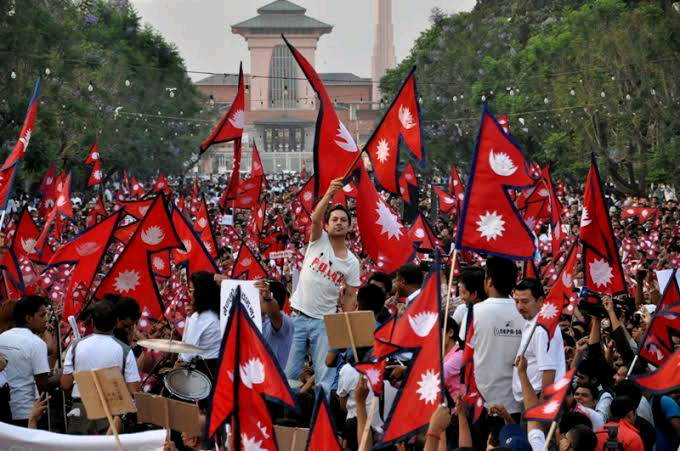
The Federal Democratic Republic of Nepal is a landlocked country in South Asia. It is bordered on different sides by the Himalayas mountain range, China, India and Bangladesh. By 2024, the population of the country was put at 31,122,387 people. Looking at the way it is squeezed in by its surrounding neighbourhoods, if Nepal had found itself as a part of Nigeria, Muhammadu Buhari would have described it as “a dot on a circle’ as he scornfully described the Igboland.
On September 8, 2025, the people of Nepal, led by Generation Z Youths, started a nation-wide protest in the country. It was a protest against corruption, nepotism and unemployment. But what triggered it off, the proverbial last straw that broke the camel’s back, is the ban on several social media platforms.
Let us recall that here in Nigeria, on April 16, 2025, while speaking during the 7th Executive Committee Meeting of the Northern Traditional Rulers’ Council, in Maiduguri, Borno State. the Sultan of Sokoto, Muhammad Sa’ad Abubakar III, described the social media as a terrorist organisation.
These are his very words: “Social media is a terrorist organisation. Somebody can sit in the comfort of his home and formulate stories and you will say that it is true. Social media is a terrorist organisation that we must deal with. Security agencies must deal with this terrorist organisation called social media.” Thanks to the social media. The criminals putting on leadership toga no longer have any place to hide.
At the beginning the Nepalese protest was peaceful. But when security forces, as they are wont to doing, wanted to stop the protest with force, it became violent. Many lives were lost. But the protest, as it has been going viral on the social media, became a huge success. The criminals destroying the country in the name of leadership were flushed out of office.
The bulk of this write-up is not mine. It belongs to Bola Ahmed Tinubu. It is the full text of the statement he made as the leader of the Action Congress of Nigeria (ACN) during the national protest he organised against President Goodluck Jonathan when the later removed oil subsidy in 2012. What I have said so far is just an introduction to his statement.
The title of his protest statement is: Removal of Oil Subsidy: President Jonathan Breaks Social Contract with the People. The statement is very long. Hence, it will be posted in three parts. The third and the last part will carry my brief remark on the current dismal state of our nation under the same Tinubu.
After carefully reading the statement, the reader will be in a better position to decide whether the time is ripe or not for the Nepalese type of revolution to happen in Nigeria before the criminals parading themselves as our leaders will completely destroy the country and the rest of us. Here is the full text of Tinubu’s statement against Jonathan for removing oil subsidy in 2012:
As Nigerians gathered with family and friends to celebrate the New Year, the federal government was baking a national cake wrapped in the scheme that would instantly make the New Year a bitter one. Barely had the public weaned itself from last year when government dropped a historic surprise on an unsuspecting nation.
PPPRA issued a statement abolishing the fuel subsidy. By this sly piece of paper, the federal government breached the social contract with the people. This government, which owes its very existence to the people’s desire to be governed by someone more humble than elitist, has turned its back on the collective will.
By bureaucratic fiat, government made the most fateful economic decision any administration has made since the inception of the Fourth Republic and it has done so with an arrogant wave of the hand as if issuing a minor regulation. Because of the terrible substance of the decision and the haughty style of its enactment, the people feel betrayed and angry.
At this moment, we know not to where this anger will lead. In good conscience, we pray against violence. Also in good conscience, it is the duty of every citizen to peacefully demonstrate and record their opposition to this draconian measure that is swiftly crippling the economy more than it will ever cure it.
By taking this step, government has tossed the people into the depths of the midnight sea. Government demands the people swim to safety under their own power, claiming the attendant hardship will build character and add efficiency to the national economy.
It is easy to make these claims when one is dry and on shore. Government would have us believe that every hardship it manufactures for the people to endure is a good thing. This is a lie. The hardships they thrust upon the poor often bear no other purpose than to keep them poor. This is such a time.
I am not calling President Jonathan an evil man. I do not believe he is perverse. However, the economic ideas controlling him are so misguided that they have a perverse impact. Because he is slave to wrong-headed economics, the people will become enslaved to greater misery. This crisis will bear his name and will be his legacy.
The people now pay a steep tax for voting him into office. The removal of the subsidy is the “Jonathan tax.” This situation shows that ideas count more than personalities. People may occupy office but how that person performs depends on the ideas that occupy his mind.
Though someday, Nigeria will have to remove the subsidy, the time to do it is not now. This subsidy removal is ill-timed and violates the condition precedent necessary before such a decision is made. First, government needs to clean up and throw away the salad of corruption in the NNPC.
Then, proceed to lay the foundation for a mass transit system in the railways and road network with long term bonds and fully develop the energy sector towards revitalizing Nigeria’s economy and easing the burden any subsidy removal may have on the people.
But we know this is about more than the fuel subsidy. It is about government’s ideas on the role of money in bettering the lives of people, about the relationship between government and the people and about the primary objective of government’s interaction in the economy.
It is about whom, among the Nigeria’s various social classes, does government most value. This is why public reaction has been heated. It is not so much that people have to spend more money. It is because people feel short-changed and sold out.
Government seeks to convince us that the Jonathan tax is an unavoidable decision mandated by immutable economic principles. If you accept their premise, you must agree with their conclusion. However, their argument falters at its inception. There are few immutable economic principles. Economics is not an exact science with unbreakable rules like physics.
Economics is no less subjective than politics. It was born an offshoot of politics and there it remains. What this government claims to be economic decisions are essentially political ones. As there is progressive politics, there is progressive economics. As there is elitist politics, there is elitist economics. It all depends on what and who in society government would rather favor. The Jonathan tax represents a new standard in elitism.
This whole issue boils down to whether government believes the general public is worth a certain level of expenditure. It is like the situation where a man dates more than one woman. To each, he promises love thus nothing can be deduced from his words. However, we know he will spend and date more on one and she will be the one he loves above the others.
When banks were in distress, government produced billions of naira out of thin air and in record time. It was explained the swift expenditure was needed to stop the banking system from imploding. There was no worry that government would be bankrupted.
To Be Concluded