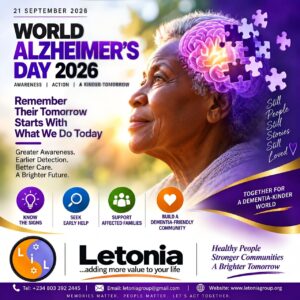
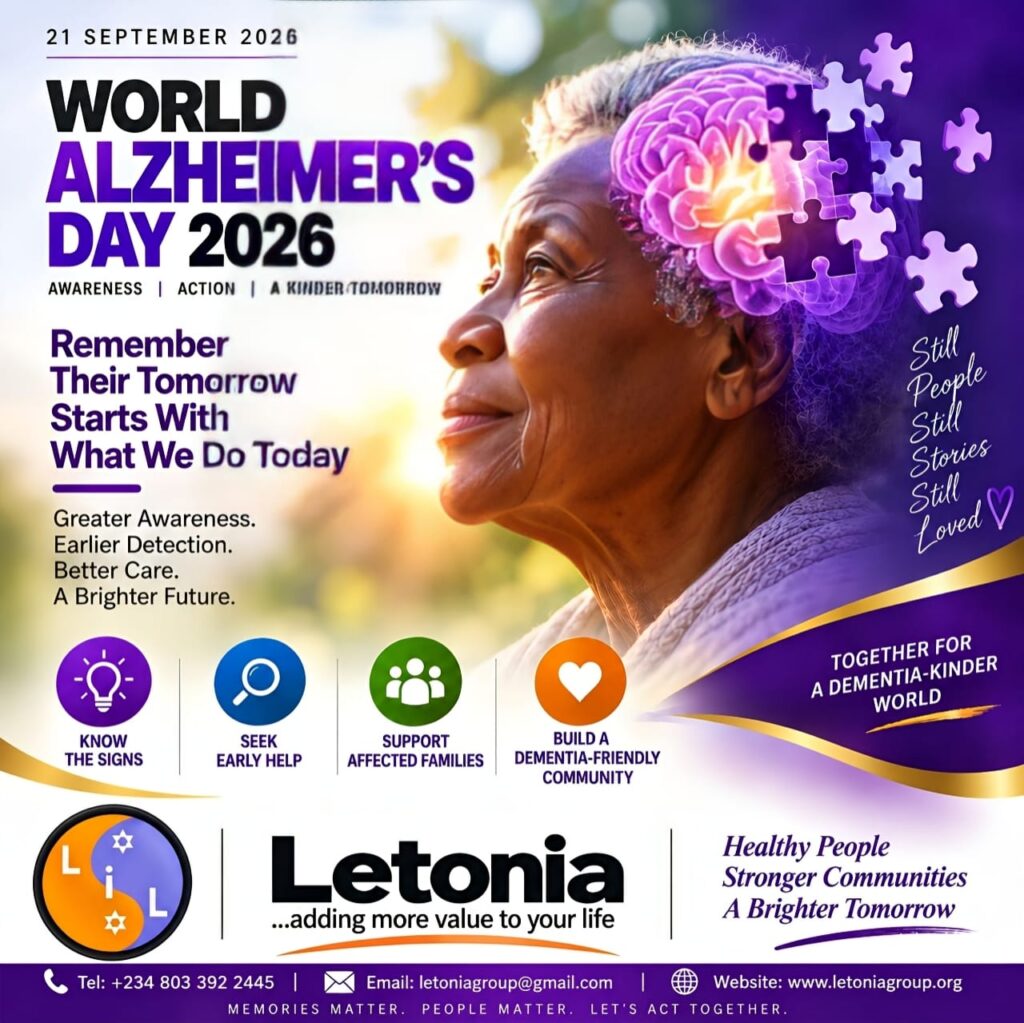
THE EARLIER YOU KNOW, THE MORE YOU CAN DO In Commemorating the 2926 World Alzheimer’s Day, Dementia Diagnosis Matters
By Livy-Elcon Emereonye
There are diseases that announce themselves loudly. They come with fever, severe pain, bleeding, swelling or obvious physical disability. They force us to pay attention.
Then there are diseases that can enter quietly.
A forgotten name here. A misplaced key there. Repeated questions. Missing an appointment. Forgetting where an important document was kept. Difficulty following a familiar recipe. Getting lost in a place that has been familiar for decades. Increasing difficulty handling money, medications or other everyday responsibilities.
At first, the explanation is often simple:
“It is old age.”
Sometimes it is.
But sometimes it is not.
Sometimes, these apparently harmless changes are early manifestations of a disease affecting the brain.
This is why the theme of World Alzheimer’s Day 2026 — “The Earlier You Know, The More You Can Do: A Dementia Diagnosis Matters” — carries such an important public-health message.
Knowing matters.
A diagnosis does not necessarily cure dementia. It does not automatically restore lost memories. It does not erase the difficulties that may lie ahead.
But knowing what is happening can transform uncertainty into understanding and understanding into action.
And in medicine, the opportunity to act earlier can be extraordinarily important.
Dementia Is Not Simply Normal Ageing
One of the most persistent misconceptions about dementia is that it is an inevitable consequence of growing old.
It is not.
Age is a major risk factor for dementia, particularly Alzheimer’s disease, but ageing itself is not dementia. Millions of older people remain cognitively healthy and functionally independent well into advanced age.
The World Health Organization (WHO) describes dementia as a syndrome involving deterioration in cognitive function beyond what might be expected from normal biological ageing. It affects memory, thinking, orientation, comprehension, calculation, learning capacity, language and judgement, and may also be accompanied by changes in emotional control, behaviour or motivation.
The distinction is important.
Everyone forgets things.
A healthy person may occasionally forget a name, misplace a phone or walk into a room and forget why they went there. Such occasional lapses, particularly when the information is later recalled, are not by themselves evidence of dementia.
The concern arises when cognitive difficulties become persistent, progressive and sufficiently significant to interfere with everyday life.
That is when medical evaluation becomes important.
Alzheimer’s Disease and Dementia Are Not Synonyms
Another important distinction is between Alzheimer’s disease and dementia.
Dementia is a clinical syndrome with multiple possible causes.
Alzheimer’s disease is the most common cause of dementia, accounting for an estimated 60–70% of dementia cases globally, according to WHO.
Other causes include vascular dementia, dementia with Lewy bodies, frontotemporal dementia and dementia associated with other neurological diseases. Some individuals may have mixed pathology, in which more than one disease process contributes to cognitive decline.
This matters because the statement “someone has dementia” does not necessarily tell us what caused it.
The cause requires proper clinical assessment.
And that is one of the reasons diagnosis matters.
The First Symptom May Not Be Memory Loss
When people hear the word Alzheimer’s, they immediately think of memory.
Memory impairment is indeed a major feature of Alzheimer’s disease, particularly in its typical presentation. But dementia can manifest in other ways.
A person may begin to:
- repeatedly ask the same questions;
- forget recently learned information;
- struggle to find familiar words;
- have difficulty planning or solving problems;
- lose the ability to perform familiar tasks;
- become confused about dates or places;
- get lost in previously familiar environments;
- experience changes in judgement;
- make unusual financial decisions;
- withdraw from social or recreational activities;
- exhibit significant changes in personality or behaviour; or
- have increasing difficulty managing medicines, appointments or household responsibilities.
The important clue is often change from the person’s previous level of functioning.
The highly organised accountant who suddenly cannot reconcile simple figures deserves attention.
The experienced cook who increasingly cannot follow a familiar recipe deserves attention.
The person who has navigated the same neighbourhood for 30 years but suddenly becomes disoriented deserves attention.
Not every such change means dementia.
But neither should every such change be dismissed as ageing.
Why Early Diagnosis Matters
The central message of this year’s theme is simple:
The earlier you know, the more you can do.
There are several reasons.
- Some Causes of Cognitive Impairment May Be Treatable
Cognitive symptoms do not automatically mean Alzheimer’s disease.
A careful medical evaluation can identify conditions that may contribute to or mimic cognitive impairment. These may include certain medication effects, nutritional deficiencies, thyroid disorders, sleep disorders, depression and other medical or neurological conditions.
Some causes may be treatable or reversible.
Consequently, assuming that every memory problem is Alzheimer’s disease can be as problematic as assuming that no memory problem deserves medical attention.
The appropriate response is evaluation.
- Diagnosis Provides a Baseline
A proper assessment can establish the person’s current cognitive and functional status.
This creates a baseline against which future changes can be monitored.
Without a baseline, families may struggle to determine whether an apparent change represents a temporary problem, normal variation or progressive deterioration.
Early assessment therefore provides useful clinical information even when the final diagnosis is uncertain.
- Appropriate Treatment Can Be Considered
There is currently no universal cure for Alzheimer’s disease.
However, management has evolved considerably.
Depending on the diagnosis, stage of disease and individual circumstances, clinicians may consider symptomatic treatments, non-drug interventions and, for selected people with early Alzheimer’s disease in healthcare systems where they are approved and accessible, newer disease-modifying therapies.
These therapies are not suitable for everybody. They require careful diagnostic confirmation, assessment of potential benefits and risks, and appropriate monitoring.
This makes accurate and timely diagnosis even more relevant.
The earlier a condition is recognised, the earlier the healthcare team can determine what options are appropriate.
- Early Diagnosis Allows Planning
Perhaps one of the most important benefits of early diagnosis is the opportunity to plan.
A person in the early stages of cognitive impairment may still be able to participate meaningfully in decisions concerning healthcare, finances, living arrangements and personal preferences.
Families can discuss:
- future healthcare preferences;
- financial and legal arrangements;
- medication management;
- driving and transportation;
- living arrangements;
- caregiving responsibilities;
- emergency contacts;
- safety considerations; and
- the person’s wishes for future care.
These conversations can become considerably more difficult when cognitive impairment has advanced.
Early knowledge therefore creates an opportunity for shared decision-making while the affected individual can still participate.
A Diagnosis Is Not a Death Sentence
The word dementia can frighten people.
Understandably so.
But a diagnosis should not erase the identity of the individual.
The person living with dementia is still a husband or wife, father or mother, brother or sister, friend, colleague, neighbour, professional, community member and human being.
He or she still deserves affection, respect, dignity and meaningful engagement.
A diagnosis may change the way a family provides care.
It should never change the value it places on the person.
Person-centred dementia care recognises that individuals have histories, personalities, preferences, relationships and values that remain important throughout the course of illness.
The disease may affect memory.
It should never become an excuse for society to forget the person.
Dementia Is Also a Family Health Issue
Dementia rarely affects only one person.
As cognitive and functional impairment progresses, family members may increasingly assume responsibility for medication administration, transportation, finances, appointments, nutrition, personal care and safety.
The burden can be substantial.
Caregivers may experience physical exhaustion, emotional distress, social isolation and financial pressure.
Consequently, dementia policy and healthcare must not focus exclusively on the diagnosed individual.
The caregiver also needs care.
Families need information.
They need respite and social support.
They need guidance about what to expect.
They need access to healthcare professionals who can answer questions without judgement.
And they need communities that understand dementia rather than stigmatise it.
What About Prevention?
Here, science requires honesty.
Not every case of dementia can be prevented.
Ageing remains a major risk factor, and genetic and other biological factors influence individual risk.
However, evidence indicates that several potentially modifiable factors across the life course are associated with dementia risk.
The 2024 update of the Lancet Commission on dementia prevention, intervention and care identified 14 potentially modifiable risk factors and estimated that addressing them collectively could potentially prevent or delay a substantial proportion of dementia cases at the population level, while emphasising that these are population-level estimates and do not mean that dementia can be prevented in every individual.
The identified factors include lower educational attainment in early life, hearing loss, high LDL cholesterol, depression, traumatic brain injury, physical inactivity, diabetes, smoking, excessive alcohol consumption, hypertension, obesity, social isolation and air pollution, as well as untreated vision loss and other factors identified in the updated evidence base.
This gives public health a significant role.
Protect the Brain by Protecting Overall Health
There is an important connection between cardiovascular and brain health.
Hypertension damages blood vessels.
Diabetes can damage the vascular system.
Smoking contributes to vascular disease.
Physical inactivity contributes to multiple chronic disease risks.
High levels of certain blood lipids are associated with cardiovascular and dementia risk.
Stroke can itself cause cognitive impairment and can increase the risk of subsequent dementia.
Thus, measures that protect cardiovascular health may also contribute to brain health.
Regular physical activity, a balanced diet, appropriate management of hypertension and diabetes, avoidance of tobacco, responsible alcohol use, treatment of hearing and vision impairment, social engagement and prevention of head injuries are therefore relevant not only to general wellbeing but also to healthy ageing.
In simple language:
What is good for the heart is often good for the brain.
Nigeria Must Take Dementia Seriously
Dementia is not merely a problem for Europe, North America or other high-income regions.
It is a global public-health issue.
WHO estimates that more than 55 million people worldwide are living with dementia, with more than 60% living in low- and middle-income countries.
As populations age, dementia will increasingly require attention across Africa.
Nigeria, with its enormous and growing population, cannot afford to treat dementia as an obscure disease of somebody else’s grandparents.
The challenge, however, is not simply the number of people who may eventually require care.
There are also issues of awareness, diagnosis, access to healthcare, specialist services, affordability, caregiver support and stigma.
In some communities, behavioural or cognitive changes may be interpreted primarily through cultural, spiritual or supernatural explanations.
Public-health education should not respond to such beliefs with ridicule.
It should respond with knowledge.
Respect for culture and respect for science do not have to be enemies.
A family can acknowledge its cultural beliefs while still taking a person with progressive cognitive decline to a qualified healthcare professional for assessment.
The message should be straightforward:
Persistent or progressive cognitive decline deserves medical attention.
Early Recognition Begins at Home
Families are often the first people to notice subtle changes.
A useful question is not simply:
“Does this person forget things?”
The better question is:
“Has this person’s memory, thinking or ability to function changed significantly from what was previously normal for them?”
If a previously independent person begins repeatedly making medication errors, becoming lost in familiar places, struggling with familiar tasks or experiencing marked changes in judgement, these observations should be taken seriously.
They do not establish a diagnosis.
But they provide a reason to seek appropriate assessment.
Do Not Wait for a Crisis
One of the unfortunate tendencies surrounding dementia is delayed presentation.
Families sometimes wait until the individual becomes severely impaired, gets lost, falls into financial difficulty, becomes unable to manage basic activities or develops a crisis before seeking help.
By then, opportunities for early planning may have diminished.
Early assessment cannot guarantee a favourable outcome.
But it can reduce uncertainty.
It can identify potentially treatable contributors.
It can establish a baseline.
It can facilitate appropriate management.
It can provide families with information.
And it can allow the individual to participate more fully in decisions about the future.
Diagnosis Converts Uncertainty into Action
There is a broader public-health principle here.
We cannot effectively manage what we refuse to recognise.
Knowing one’s blood pressure creates an opportunity to manage hypertension.
Knowing one’s blood glucose creates an opportunity to address diabetes.
Knowing one’s cardiovascular risk creates an opportunity to modify risk factors.
And knowing that cognitive changes may represent dementia creates an opportunity for assessment, planning, treatment where appropriate and support.
Diagnosis is therefore more than a label.
Diagnosis is information.
And information creates options.
That is the real power of early knowledge.
Let Us Change the Conversation
On this World Alzheimer’s Day, we should move dementia out of the shadows.
We should stop treating every cognitive problem as an inevitable consequence of ageing.
We should stop treating dementia as something too frightening to discuss.
We should stop allowing stigma to prevent families from seeking help.
Instead, we should create a culture in which cognitive health is considered part of routine health.
Healthcare professionals should be equipped to recognise cognitive decline.
Families should know the warning signs.
Caregivers should receive support.
Researchers should continue searching for better diagnostic methods, preventive strategies and treatments.
Governments and health systems should strengthen dementia-related services.
And communities should learn that dementia does not diminish the humanity of the person affected.
The Earlier You Know, The More You Can Do
There is a profound message hidden within the theme of World Alzheimer’s Day 2026.
The earlier you know, the more you can do.
Not everything can be prevented.
Not every case can be cured.
Not every progression can be stopped.
But much can still be done.
We can recognise.
We can investigate.
We can treat what is treatable.
We can manage what is manageable.
We can plan.
We can support.
We can reduce risk.
We can protect dignity.
We can prepare families.
We can continue research.
And above all, we can replace fear with knowledge.
The person who forgets a name may simply have forgotten a name.
The person who misplaces the keys may simply have misplaced the keys.
But when memory, thinking, behaviour or everyday functioning begin to change persistently and progressively, we should not simply wave the changes away with the familiar phrase:
“It is just old age.”
Sometimes it is not.
Sometimes the brain is telling us that something deserves attention.
Let us listen.
Because early knowledge may not give us every answer.
But it can give us something immensely valuable: the opportunity to do what can still be done.
And that is why a dementia diagnosis matters.
PS: Dr. Emereonye could be reached on: +234 803 392 2445
References
- World Health Organization (WHO). Dementia. WHO Fact Sheet. Updated 15 March 2023. https://www.who.int/news-room/fact-sheets/detail/dementia
- Livingston G, Huntley J, Liu KY, et al. Dementia prevention, intervention, and care: 2024 report of the Lancet standing Commission. The Lancet. 2024;404(10452):572–628.
doi:10.1016/S0140-6736(24)01296-0 - World Health Organization. Global status report on the public health response to dementia. Geneva: World Health Organization; 2021. https://www.who.int/publications/i/item/9789240033245
- World Health Organization. Risk reduction of cognitive decline and dementia: WHO guidelines. Geneva: World Health Organization; 2019. https://www.who.int/publications/i/item/9789241550543
- National Institute on Aging (NIA). What Is Dementia? Symptoms, Types, and Diagnosis. U.S. National Institute on Aging. https://www.nia.nih.gov/health/what-is-dementia
- National Institute for Health and Care Excellence (NICE). Dementia: assessment, management and support for people living with dementia and their carers (NG97). Updated guidance. https://www.nice.org.uk/guidance/ng97
- Alzheimer’s Disease International (ADI). World Alzheimer Report. Alzheimer’s Disease International. https://www.alzint.org/resource/world-alzheimer-report/
- National Institute on Aging. Alzheimer’s Disease Fact Sheet. U.S. National Institute on Aging. https://www.nia.nih.gov/health/alzheimers-and-dementia
- World Health Organization. Global action plan on the public health response to dementia 2017–2025. Geneva: WHO; 2017. https://www.who.int/publications/i/item/9789241513487
- Livingston G, Sommerlad A, Orgeta V, et al. Dementia prevention, intervention, and care. The Lancet. 2017;390(10113):2673–2734.
doi:10.1016/S0140-6736(17)31363-6Note: