THE BANE AND BONDAGE OF MENTAL MYOPIA: When Personal Perplexity Becomes Principle and Personal Perspective Becomes Precept
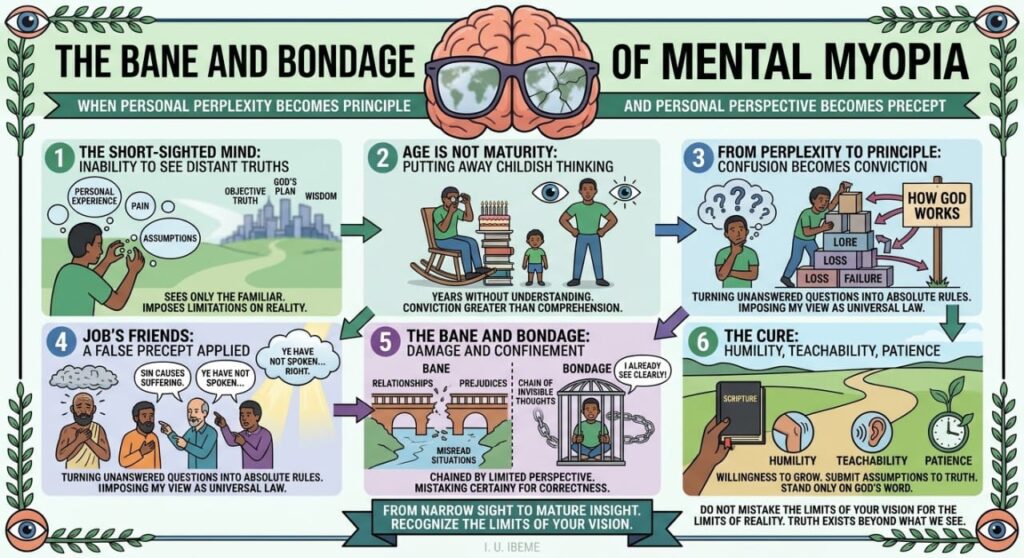
Many grow up and grow old, yet remain mentally myopic, never attaining maturity. Immaturity turns personal perplexity into principle and mistakes personal perspective for precept.
1. The Short-Sighted Mind
Physical myopia is the inability to see distant objects clearly. Mental myopia is the same limitation of the mind: the inability or unwillingness to see beyond one’s immediate experience, personal pain, inherited assumptions or limited perspective. The myopic person sees only what is near and familiar, and assumes that what lies beyond his sight either does not exist or cannot be true.
Peter’s immediate concern is spiritual unfruitfulness. The believer who lacks the qualities of Christian growth “is blind, and cannot see afar off” (2 Peter 1:9). We may apply the image more broadly: a deficiency in growth shortens vision. The problem is not necessarily a lack of information, years or experience, but a lack of the maturity needed to interpret them rightly.
2. Age Is Not Maturity
“When I was a child, I spake as a child, I understood as a child, I thought as a child: but when I became a man, I put away childish things” (1 Corinthians 13:11).
Maturity requires putting away childish ways of thinking.
Yet many accumulate birthdays, titles, experiences and opinions without any increase in wisdom.
Paul exhorts, “In malice be ye children, but in understanding be men” (1 Corinthians 14:20).
Christian maturity is not the mere passage of time. It is the development of sound judgment, discernment and humility, and the capacity to distinguish personal impressions from established truth. Years may increase without understanding enlarging, and conviction may grow stronger while comprehension stays narrow.
3. From Perplexity to Principle
One of the most dangerous forms of myopia is turning personal perplexities into universal principles.
A person meets a loss, a betrayal, a failure or an unanswered prayer. Unable to explain it, he draws a conclusion and elevates it into a rule for interpreting everyone else’s life:
“This is how people are.” “That is how God works.” “Anyone who suffers must have done something wrong.”
What began as confusion becomes conviction, and what began as one man’s perspective becomes a precept imposed on others. But a genuine experience does not automatically produce a correct explanation, and a sincere conviction is not automatically universal truth. The error lies not in having a perspective, but in treating it as exhaustive, unquestionable and binding on all.
4. Job’s Friends: When Perspective Becomes False Precept
Job’s friends held a theological assumption: the righteous prosper and the wicked suffer. That principle reflects part of biblical wisdom, but they applied it rigidly and concluded that Job’s afflictions proved his wickedness. Their mistake was not that they tried to interpret suffering. It was that they explained God’s dealings through a framework too narrow for the facts before them.
God’s verdict was explicit: “Ye have not spoken of me the thing that is right, as my servant Job hath” (Job 42:7). Their limited understanding had hardened into precept, and their confidence in it led them to misrepresent both Job and God. Myopia turns spiritually dangerous when we defend our explanations of God’s actions more vigorously than we seek His truth.
5. The Bane and Bondage
Mental myopia is a bane because it damages judgment, distorts relationships, encourages prejudice and misreads other people’s experiences. It is a bondage because the person confined by a narrow view mistakes his limitation for enlightenment. Believing he already sees clearly, he sees no need to seek further light or submit his conclusions to correction.
Solomon counsels, “Trust in the LORD with all thine heart; and lean not unto thine own understanding” (Proverbs 3:5, KJV), and warns, “There is a way which seemeth right unto a man, but the end thereof are the ways of death” (Proverbs 14:12). Human understanding is not worthless, but it is limited, and it must never be treated as the final authority.
The chain is invisible because the prisoner does not recognise his confinement. He mistakes certainty for correctness, stubbornness for strength, and unwillingness to reconsider for unwavering conviction.
6. The Cure: Humility, Teachability and Patience
The cure is not simply more years, information or experience. It is a willingness to grow beyond one’s present understanding. Paul names the goal as “a perfect [mature] man, unto the measure of the stature of the fulness of Christ,” so that we are “no more children, tossed to and fro” (Ephesians 4:13-14). Three qualities are essential:
- Humility: acknowledging that our knowledge is partial and our experience does not reveal the whole counsel of God revealed in the transgenerational transcendent truth of the canonical Scriptures.
- Teachability: letting Scripture, sound reasoning, wise counsel and the legitimate experiences of others examine and correct our assumptions.
- Patience: waiting, reflecting and seeking God’s wisdom rather than hastily converting unanswered questions into unquestionable conclusions.
MATURITY does not mean abandoning conviction. It means distinguishing “conviction grounded in truth” from “certainty built on incomplete understanding.” Nor does HUMILITY mean accepting every contrary opinion. It means examining our own position honestly before dismissing another’s. The mature mind does not surrender discernment; it disciplines it.
Conclusion: From Narrow Sight to Mature Insight
The tragedy of mental myopia is not that people have a perspective. Everyone does, and every perspective can hold real insight. The tragedy is that they absolutize it, mistaking a partial view for the whole truth.
True maturity begins when we recognise that our perspective may be valid without being exhaustive, our experience genuine without being universal, and our conviction sincere without necessarily being correct.
So hold your perspectives humbly, test your conclusions honestly, remain teachable, and only stand firmly when it is on the truth of God’s Word.
- Do not turn what you cannot explain into a principle.
- Do not turn what you have experienced into a precept for everyone.
- And do not mistake the limits of your vision for the limits of reality.
The cure for mental myopia is not merely to see more, but to recognise how much more there is to see.
Grace to you.
I. U. Ibeme