SHETTIMA: THE LOYAL DEPUTY POWERING TINUBU’S RENEWED HOPE AGENDA

By Felix Oti, Awka
In democratic governance, few relationships are as consequential as that between a President and his Vice President. When built on mutual trust, complementary strengths, shared vision and disciplined loyalty, it becomes a stabilising force for the nation. When marked by rivalry and ego, it weakens the entire administration.
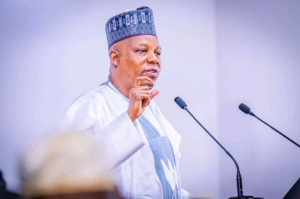
In the Renewed Hope government of President Bola Ahmed Tinubu, GCFR, that partnership has been defined by competence, intellectual depth, political courage, and unwavering commitment to national transformation. At the centre stands Senator Kashim Shettima, GCON, Vice President of the Federal Republic of Nigeria — a true asset to the Presidency and to the Nigerian people.
From the earliest stages of the 2023 presidential project, Shettima distinguished himself as one of the most consistent and courageous advocates of Asiwaju Bola Tinubu’s candidacy within the Northern political establishment. At a time when many preferred to sit on the fence, he deployed intellect and influence to build bridges across regional, generational and factional lines. His decision to step aside from a secured Senate ticket to serve as running mate was not a casual calculation. It was an act of conviction that Nigeria needed Tinubu’s experience, temperament and reformist outlook.
As Chairman of the National Economic Council, Shettima has provided steady intellectual and administrative ballast to the bold reforms that define this administration. The removal of fuel subsidy, unification of the multiple foreign exchange windows, and ongoing tax reforms demanded not only presidential courage but also a deputy capable of articulating the rationale with clarity, defending the trajectory with facts, and coordinating implementation across the federation.
He has discharged that responsibility with distinction. He has repeatedly reminded Nigerians in clear, unapologetic language that these reforms rescued the economy from the brink of collapse. Foreign reserves that once hovered dangerously low have been significantly strengthened. International credit ratings have improved. The economy has returned to a path of measurable growth. These are not abstract statistics; they are the hard-won foundation for sustainable prosperity.
Beyond macroeconomic stabilisation, Shettima has shown practical interest in the real economy of ordinary Nigerians. Through MSME Clinics across several states, the landmark Aso Accord for Economic and Financial Inclusion, targeted agricultural interventions, and support for programmes such as the Nigerian Education Loan Fund, he has helped translate policy into opportunities for farmers, small business owners, women entrepreneurs and young people.
His commitment to agricultural modernisation, through official programmes and the Kashim Shettima Foundation, reflects a deep understanding that food security and rural prosperity remain central to national stability. In an era when many speak of agriculture only during campaigns, Shettima has treated it as a strategic national priority.
Equally important is his role as a bridge-builder in a diverse and often polarised federation. Coming from Borno State, which has endured the worst of insurgency, Shettima brings lived experience of the human cost of insecurity and the need for coordinated security and developmental responses.
His engagement with the South-East and other zones has been marked by respect, accessibility and genuine interest in regional priorities — whether advocating for critical infrastructure, supporting the South-East Development Commission, engaging traditional rulers, or speaking about the region’s place in national leadership succession. In a country where regional suspicion can be weaponised, such bridge-building is not a soft skill; it is a strategic national asset.
Loyalty is tested not in celebration but in moments of pressure. Throughout this administration, Shettima has remained a steadfast defender of the President’s vision. He has refused the destructive games of internal rivalry, leakage and competing centres of power that undermined previous governments.
As we approach the 2027 general elections, continuity of this partnership carries strategic importance. Nigeria still faces challenges in security, infrastructure, industrialisation, human capital development and deepening reforms. Completing what has begun will require the same blend of presidential vision and vice-presidential diligence.
Senator Kashim Shettima is not a ceremonial deputy. He is a former two-term Governor of Borno State who governed under extraordinarily difficult security conditions, a former Senator, and a banker who understands financial systems and economic management. Above all, he is a loyal progressive who has subordinated personal ambition to the collective success of the Tinubu project.
In him, the Presidency possesses a genuine asset. The partnership that has carried us this far must be sustained, strengthened and renewed.