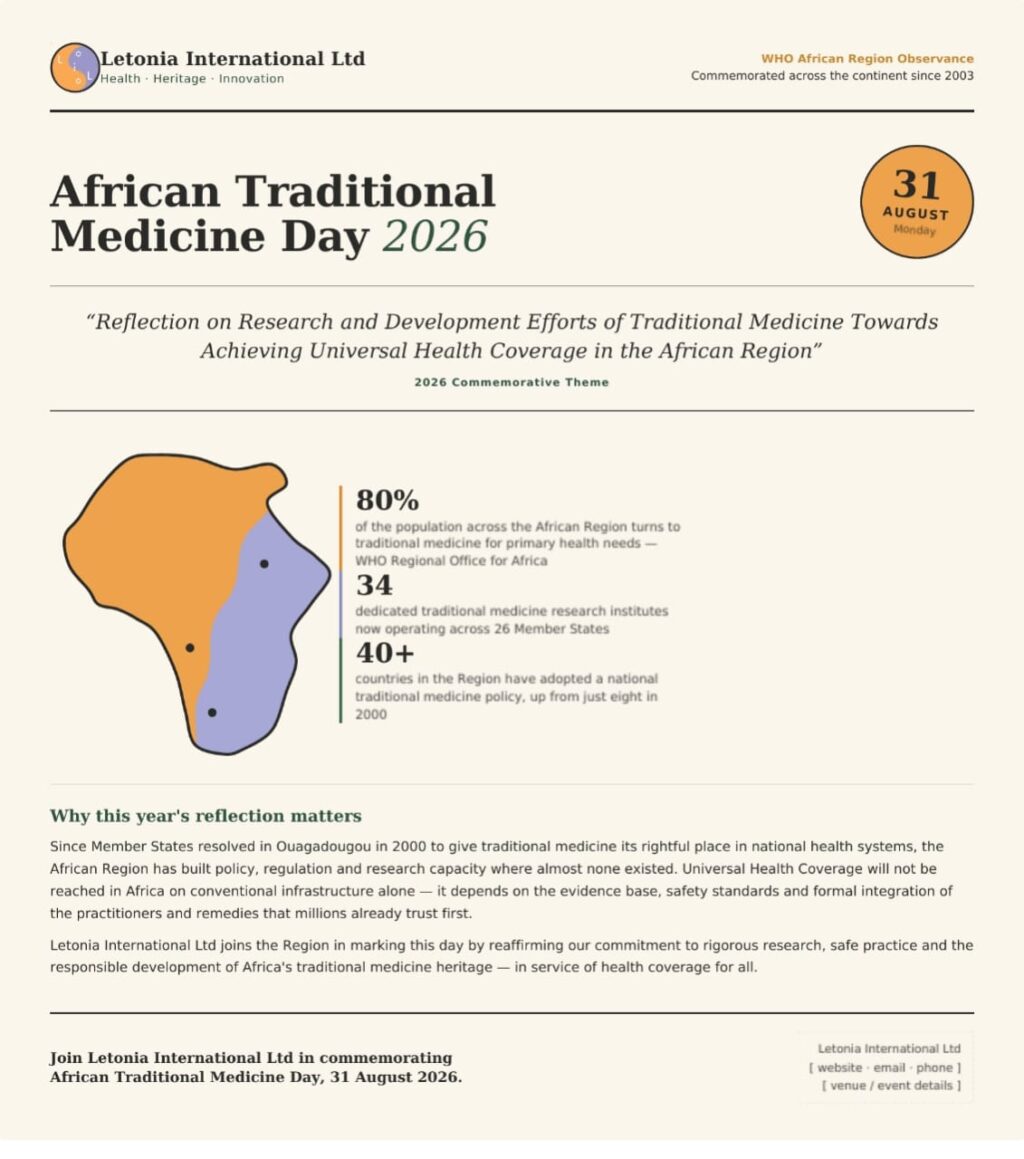
REFLECTION ON RESEARCH AND DEVELOPMENT EFFORTS OF TRADITIONAL MEDICINE TOWARDS ACHIEVING UNIVERSAL HEALTH COVERAGE IN THE AFRICAN REGION1 A Scientific and Public Health Reflection to Mark the 2026 African Traditional Medicine Day
By Livy-Elcon Emereonye
Introduction
Every year on August 31, the African Region commemorates African Traditional Medicine Day, providing an opportunity to acknowledge the historical, cultural, scientific and public-health significance of traditional medicine across the continent.
The 2026 theme, “Reflection on Research and Development Efforts of Traditional Medicine Towards Achieving Universal Health Coverage in the African Region,” is particularly timely. It challenges Africa to move beyond simply acknowledging traditional medicine as part of its cultural heritage and to critically examine how research, innovation, regulation and responsible integration can transform its potential into measurable health benefits.
Traditional medicine remains an important component of healthcare in many African communities. The World Health Organization (WHO) recognises that traditional, complementary and integrative medicine is used by millions of people globally and can contribute to health and wellbeing when appropriately regulated and supported by evidence.
In Africa, traditional medicine is particularly relevant because healthcare access remains uneven. Distance to health facilities, cost, shortages of health workers, inadequate infrastructure and cultural preferences influence where and how people seek care.
Consequently, the central question should no longer be whether traditional medicine has a place in African healthcare. It already occupies one.
The more important questions are: What works? What does not work? What is safe? What is effective? How should quality be assured? What traditional practices can be scientifically validated? How can promising medicinal resources be developed into standardised health products? And how can proven interventions contribute appropriately to Universal Health Coverage (UHC)?
These are fundamentally questions of research and development (R&D).
Traditional Medicine and Africa’s Public-Health Reality
Africa continues to confront a complex combination of communicable and non-communicable diseases, maternal and child health challenges, nutritional disorders, emerging infections and increasing demands associated with ageing and chronic disease.
At the same time, health systems in many countries face persistent constraints involving financing, infrastructure, human resources, medicine availability and equitable access.
Traditional medicine has consequently remained an accessible source of healthcare for many communities.
Its importance derives partly from its proximity, affordability, cultural acceptability and community embeddedness. Traditional health practitioners are often members of the communities they serve and may be consulted before, alongside or instead of conventional healthcare providers.
This reality creates both an opportunity and a responsibility.
Ignoring traditional medicine does not make its use disappear. Instead, it can create a parallel system operating with inadequate documentation, inconsistent quality assurance and insufficient safety surveillance.
Public health therefore requires an evidence-informed approach.
Traditional medicine should neither be romanticised nor dismissed. Its practices and products should be evaluated according to the same fundamental public-health principles that apply to other health interventions: quality, safety, efficacy, effectiveness, affordability, equity and appropriateness.
From Indigenous Knowledge to Scientific Evidence
Africa possesses an extraordinary body of indigenous knowledge concerning medicinal plants, foods, therapeutic practices and approaches to health and wellbeing.
This knowledge represents an important intellectual and cultural resource.
However, traditional knowledge is vulnerable to loss. As generations change and traditional knowledge holders age, valuable information can disappear unless systematically documented and preserved.
Documentation should therefore form an important part of African traditional medicine research.
But documentation should not become exploitation.
Indigenous communities and traditional knowledge holders should be recognised as stakeholders and partners. Research involving indigenous knowledge should observe ethical requirements concerning prior informed consent, intellectual property, ownership, confidentiality where appropriate and equitable benefit-sharing.
Scientific research can subsequently investigate promising traditional practices using appropriate methodologies.
This may include ethnobotanical research, phytochemical analysis, pharmacological investigation, toxicological assessment, formulation development, preclinical studies and clinical trials.
Importantly, traditional use is evidence of historical experience, but it is not by itself conclusive evidence of clinical efficacy or safety.
Equally, a lack of modern clinical research should not automatically be interpreted as evidence that every traditional intervention is ineffective.
The appropriate response is to conduct rigorous research.
Evidence should be generated rather than assumed.
Research and Development as a Bridge Between Knowledge Systems
The traditional-versus-modern medicine debate is often presented as though Africa must choose one system over the other.
This is an unnecessarily polarising approach.
Science does not require the rejection of indigenous knowledge. Rather, indigenous knowledge can generate hypotheses that science can investigate.
Traditional knowledge may point researchers toward a medicinal plant, preparation or therapeutic practice. Modern scientific techniques can then investigate its chemical constituents, mechanisms of action, toxicity, pharmacokinetics and potential therapeutic value.
This creates a potentially productive relationship between indigenous knowledge and contemporary science.
Such collaboration could involve traditional health practitioners, physicians, pharmacists, pharmacologists, botanists, chemists, public-health scientists, epidemiologists, anthropologists and pharmaceutical researchers.
The objective should be neither to replace traditional knowledge with biomedical science nor to accept traditional claims without scrutiny.
The objective should be evidence-informed integration and innovation.
Medicinal Plants and Pharmaceutical Innovation
Africa’s biodiversity represents one of its potentially important scientific and economic assets.
Medicinal plants have historically provided compounds that have contributed to modern therapeutics. The scientific investigation of natural products has led to important medicines, demonstrating that nature can provide valuable starting points for pharmaceutical discovery.
However, the journey from a medicinal plant to a reliable therapeutic product is complex.
A plant traditionally used for a particular condition may contain numerous chemical constituents. Its composition may vary according to species, geographical location, soil conditions, climate, season, harvesting method, processing and storage.
Therefore, a credible medicinal product requires attention to identity, purity, potency, dosage, contaminants, stability, reproducibility and manufacturing quality.
This is why standardisation is indispensable.
Africa should seek to develop a stronger pipeline through which promising traditional medicinal resources can progress from ethnobotanical observation to laboratory investigation, formulation development, clinical evaluation, regulatory assessment and, where justified by evidence, responsible commercialisation.
This could contribute not only to healthcare but also to local pharmaceutical manufacturing, employment, scientific capacity and economic development.
Clinical Research: The Critical Missing Link
One of the major challenges facing traditional medicine is the limited availability of high-quality clinical evidence for many interventions.
Laboratory findings are important, but laboratory activity does not automatically translate into clinical effectiveness.
An extract may demonstrate biological activity in vitro without producing a meaningful therapeutic effect in humans. Conversely, a complex traditional preparation may have effects that require more sophisticated research designs to understand.
Clinical research is therefore essential.
Appropriately designed studies can investigate:
- efficacy and effectiveness;
- dosage and treatment duration;
- adverse effects;
- drug-herb interactions;
- contraindications;
- vulnerable populations;
- long-term safety; and
- real-world effectiveness.
Africa should strengthen its capacity to conduct such research within African populations and according to African health priorities.
Research questions should reflect the continent’s actual disease burden and healthcare needs rather than being driven exclusively by external commercial interests.
Safety Must Remain Non-Negotiable
A scientifically responsible approach to traditional medicine must place patient safety at the centre.
The assumption that something is safe because it is “natural” is scientifically incorrect.
Medicinal plants contain pharmacologically active compounds. Those compounds may produce beneficial effects, adverse effects or both.
Traditional medicinal products may also be affected by problems involving incorrect plant identification, contamination, adulteration, inappropriate preparation, variable dosage or unsafe storage.
Potential interactions between herbal medicines and pharmaceutical drugs are another important concern, particularly among patients who use multiple healthcare systems simultaneously.
For this reason, Africa needs stronger systems for:
quality assurance, adverse-event reporting, pharmacovigilance, laboratory testing, product surveillance and practitioner regulation.
Scientific research must therefore investigate risks as carefully as it investigates benefits.
The purpose of science is not to prove a predetermined position. It is to establish what is true—or most strongly supported by evidence—and to identify the circumstances under which an intervention can be used safely and effectively.
Regulation and Responsible Integration
Research cannot deliver public-health benefits without effective regulation.
African countries have made progress in developing national policies and regulatory frameworks for traditional medicine, but considerable differences remain in areas such as practitioner registration, product standards, manufacturing, quality control, therapeutic claims and pharmacovigilance.
Effective regulation should protect the public while creating an environment in which responsible innovation can flourish.
Traditional health practitioners should receive appropriate recognition, training and regulatory oversight. Manufacturers should meet quality requirements. Products should be appropriately labelled, and therapeutic claims should correspond to available evidence.
Regulatory authorities must also address misleading claims.
No traditional or conventional medicine should be promoted as a universal cure for every disease. Such claims can delay appropriate treatment, expose vulnerable people to harm and undermine legitimate research.
Good regulation is therefore not an obstacle to traditional medicine; it is a prerequisite for its sustainable development.
Traditional Medicine and Universal Health Coverage
Universal Health Coverage seeks to ensure that everyone can access the health services they need without financial hardship.
Traditional medicine can potentially contribute to UHC through accessibility, affordability, cultural acceptability and community participation.
But integration into UHC must be evidence-informed.
It does not mean that every traditional therapy should automatically become part of national health services. Nor does it mean that conventional medicine should be displaced.
Rather, interventions that demonstrate appropriate evidence of safety, efficacy, effectiveness and quality should be considered for appropriate roles within health systems.
Integration should also include appropriate referral pathways.
Traditional practitioners who encounter conditions requiring emergency or specialised medical intervention should be able to refer patients promptly. Likewise, conventional health professionals should be sufficiently knowledgeable about traditional medicine use to communicate effectively with patients and identify possible interactions or risks.
The guiding principle must remain:
The patient comes first.
Building African Research Capacity
If Africa is serious about harnessing traditional medicine for UHC, investment in research capacity is essential.
This includes laboratories, clinical research facilities, analytical technologies, pharmaceutical-development capacity, regulatory science and appropriately trained researchers.
Universities and research institutions should encourage interdisciplinary programmes linking:
pharmacognosy, pharmacy, medicine, public health, pharmacology, toxicology, botany, chemistry, biotechnology, epidemiology, anthropology, health economics and health policy.
Young African scientists should be encouraged to investigate indigenous medicinal resources using contemporary scientific technologies.
This is more than a health investment.
It is also an investment in African scientific sovereignty.
Africa should increasingly become a producer of knowledge and health technologies rather than primarily a consumer of technologies developed elsewhere.
The Economic and Developmental Opportunity
Traditional medicine research also has an economic dimension.
Africa possesses substantial biological resources and indigenous knowledge but remains heavily dependent on imported medicines and pharmaceutical products.
Developing scientifically validated traditional medicine products could strengthen local value chains involving:
cultivation → sustainable harvesting → processing → extraction → formulation → quality assurance → manufacturing → distribution.
This could generate employment and support local industries.
However, commercialisation must be balanced with environmental sustainability.
Unsustainable harvesting can threaten medicinal plant populations and biodiversity. Conservation, therefore, must become an integral component of traditional medicine development.
Africa should invest in cultivation and sustainable production systems rather than relying exclusively on uncontrolled harvesting from the wild.
Protecting Indigenous Knowledge
As traditional medicine becomes increasingly commercialised and scientifically investigated, questions of ownership and benefit-sharing become more important.
Indigenous communities should not simply provide knowledge while external researchers or corporations capture the resulting economic benefits.
Research partnerships should incorporate mechanisms for recognition, consent, intellectual-property protection and equitable benefit-sharing.
The Nagoya Protocol on Access and Benefit-sharing provides an important international framework for addressing access to genetic resources and the fair and equitable sharing of benefits arising from their utilisation.
Protecting indigenous knowledge is therefore not only an ethical responsibility; it can also encourage communities to participate actively in conservation, documentation and research.
Digital Technology and the Future
Digital technology offers additional opportunities.
African countries can develop digital repositories for medicinal plants and traditional knowledge, subject to appropriate safeguards. Artificial intelligence and computational approaches can support natural-product discovery and chemical analysis. Digital platforms can assist with practitioner education, research collaboration and pharmacovigilance.
However, technology must complement rather than replace scientific validation.
No algorithm can substitute for appropriate clinical evidence, ethical review, quality control and regulatory oversight.
A New African Research Agenda
The 2026 theme should stimulate a renewed African research agenda built around priority health needs.
Key priorities should include:
- Systematic documentation and preservation of indigenous medical knowledge.
- Scientific investigation of promising medicinal plants and traditional practices.
- Standardisation and quality assurance of traditional medicine products.
- Rigorous preclinical and clinical research.
- Strengthening pharmacovigilance and safety surveillance.
- Harmonisation of appropriate regulatory standards across countries.
- Protection of indigenous knowledge and equitable benefit-sharing.
- Sustainable cultivation and conservation of medicinal resources.
- Development of African research and manufacturing capacity.
- Health-economic research on affordability and cost-effectiveness.
- Implementation research on responsible health-system integration.
- Strengthened regional and international research collaboration.
Above all, research must progress beyond publication to translation.
A discovery that remains confined to a laboratory or academic journal has limited population-health impact.
Discovery must lead to translation, and translation must ultimately lead to improved health outcomes.
From Celebration to Transformation
African Traditional Medicine Day should therefore be more than an annual ceremonial event.
It should become an opportunity for reflection, accountability and action.
Africa should ask:
How much is being invested in traditional medicine research?
How many promising discoveries have progressed from laboratory research to clinical evaluation?
How many traditional medicine products meet appropriate quality standards?
How effective are pharmacovigilance systems?
How much indigenous knowledge is being systematically preserved?
How much value is Africa capturing from its own medicinal biodiversity?
And perhaps most importantly:
How much of this research is actually improving the health and wellbeing of African populations?
These questions matter because the ultimate measure of research is not the number of papers published, but the knowledge generated, innovations developed, lives improved and inequalities reduced.
Conclusion
The 2026 African Traditional Medicine Day theme, “Reflection on Research and Development Efforts of Traditional Medicine Towards Achieving Universal Health Coverage in the African Region,” provides Africa with an opportunity to rethink the place of traditional medicine in contemporary healthcare.
Africa cannot afford to ignore credible opportunities to improve access to safe, effective, affordable and culturally acceptable healthcare.
Traditional medicine represents one such opportunity—but its future must be guided by evidence rather than sentiment; science rather than speculation; regulation rather than unrestrained commercialisation; sustainability rather than exploitation; and partnership rather than polarisation.
The objective should not be to prove that traditional medicine is superior to conventional medicine, nor to establish that conventional medicine is inherently superior to traditional medicine.
The objective should be to determine, through rigorous research and responsible public-health practice, what works, what is safe, what is affordable, what is culturally appropriate and how proven interventions can contribute to better health outcomes.
Africa possesses an extraordinary inheritance of indigenous medical knowledge and biological resources.
The responsibility of the present generation is to ensure that this inheritance is neither lost through neglect nor exploited through irresponsible commercialisation.
It should be documented, scientifically investigated, validated where appropriate, standardised, regulated, sustainably developed and translated into health solutions that serve humanity.
Universal Health Coverage requires health systems capable of combining access, quality, affordability, safety, equity and innovation.
Traditional medicine can contribute to that vision—but only through a deliberate commitment to research, development, responsible integration and continuous evaluation.
As Africa commemorates African Traditional Medicine Day 2026, the message should therefore be unequivocal:
Africa must not merely preserve its traditional medicine heritage. It must research it, validate it, regulate it, innovate through it and responsibly harness its proven potential for the health and wellbeing of present and future generations.
Happy African Traditional Medicine Day 2026!
PS: Dr. Emereonye could be reached on: +234 803 3922 445
REFERENCES
- World Health Organization (WHO). WHO Traditional Medicine Strategy: 2014–2023. Geneva: World Health Organization; 2013.
https://www.who.int/publications/i/item/9789241506096 - World Health Organization (WHO). Global Traditional Medicine Strategy 2025–2034. Geneva: World Health Organization; 2025.
https://www.who.int/publications/i/item/9789240117137 - World Health Organization Regional Office for Africa. Traditional Medicine Strategy 2013–2023. Brazzaville: WHO Regional Office for Africa.
https://www.afro.who.int/publications/regional-strategy-traditional-medicine-2013-2023 - World Health Organization. WHO Global Report on Traditional and Complementary Medicine 2019. Geneva: World Health Organization; 2019.
https://www.who.int/publications/i/item/978924151536 - World Health Organization. Traditional Medicine. WHO Fact Sheet. Geneva: World Health Organization.
https://www.who.int/news-room/questions-and-answers/item/traditional-medicine - World Health Organization. Universal Health Coverage (UHC). Geneva: World Health Organization.
https://www.who.int/health-topics/universal-health-coverage - World Health Organization Regional Office for Africa. The State of Health in the African Region. Brazzaville: WHO Regional Office for Africa.
https://www.afro.who.int/ - World Health Organization. WHO Guidelines on Good Agricultural and Collection Practices (GACP) for Medicinal Plants. Geneva: World Health Organization; 2003.
https://www.who.int/publications/i/item/9241546271 - World Health Organization. WHO Guidelines for Assessing Quality of Herbal Medicines with Reference to Contaminants and Residues. Geneva: World Health Organization; 2007.
https://www.who.int/publications/i/item/9789241594448 - United Nations. Convention on Biological Diversity: Nagoya Protocol on Access to Genetic Resources and the Fair and Equitable Sharing of Benefits Arising from their Utilization. Montreal: Secretariat of the Convention on Biological Diversity; 2011.
https://www.cbd.int/abs/ - Petrovska BB. Historical review of medicinal plants’ usage. Pharmacognosy Reviews. 2012;6(11):1–5.
https://doi.org/10.4103/0973-7847.95849 - Fabricant DS, Farnsworth NR. The value of plants used in traditional medicine for drug discovery. Environmental Health Perspectives. 2001;109(Suppl 1):69–75.
https://doi.org/10.1289/ehp.01109s169 - Calixto JB. Twenty-five years of research on medicinal plants in Latin America: a personal view. Journal of Ethnopharmacology. 2005;100(1–2):131–134.https://doi.org/10.1016/j.jep.2005.06.004
- World Health Organization. WHO Guidelines for the Assessment of Herbal Medicines. Geneva: World Health Organization.
https://www.who.int/ - United Nations. Transforming our World: The 2030 Agenda for Sustainable Development. New York: United Nations; 2015. https://sdgs.un.org/2030agenda