NPC CHARGES JOURNALISTS TO INFORM THE PUBLIC ACCURATELY WITHOUT SENSATIONALISM
By Felix Oti, Awka
The Nigerian Press Council (NPC), in collaboration with Rounties Consults Nigeria Limited, has charged journalists to uphold their crucial responsibility of informing the public accurately without sensationalism.
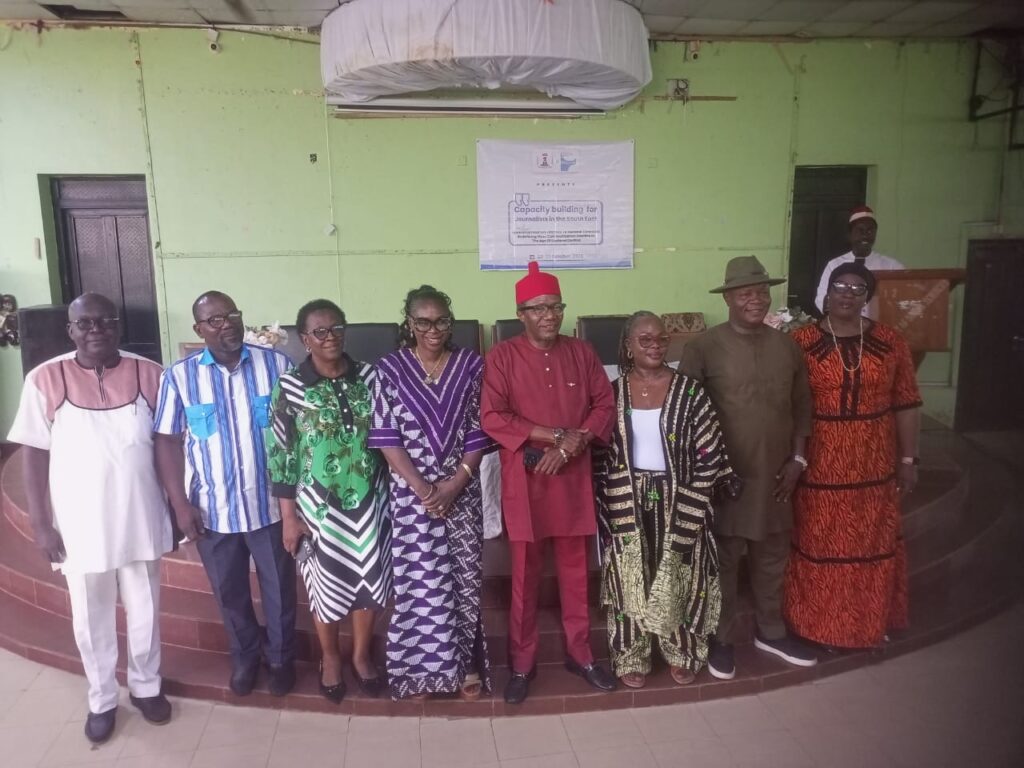
The charge was given during a three-day capacity building workshop held in Awka, Anambra State, with the theme: “Capacity Building for Journalists in the South-East on Understanding and Identifying Hate Speech and Inflammatory Language in Political Discourse and Dissipating Them.”*
Speaking at the workshop were the Commissioner for Information, Anambra State, Dr. Law Mefor; the Executive Secretary of NPC, Dr. Dili Ezughah, represented by Mrs. Chinyere Facah; the Head of Department of Electronic Media, Broadcasting and New Media, Nnamdi Azikiwe University, Awka, Dr. Cornelius Ugwueze; the Director of Research and Documentation (NPC), Mrs. Anumudu Stella; and Prof. Chinwe Uzochukwu.
In their separate presentations, they urged journalists to focus on ethical and responsible journalism by communicating factually and avoiding criminal fabrication.
WORKSHOP AIMED AT STRENGTHENING PROFESSIONAL JOURNALISM
According to the organizers, the workshop is aimed at strengthening professional journalism and promoting responsible media practice, particularly in political reporting and election-related matters.
In his welcome address, the NPC noted that the topic is timely and critical to national peace, unity and democratic development.
“While political discourse is essential to democracy, the use of hate speech, inflammatory language and assassination rhetoric can deepen social divisions, provoke hostility and threaten peaceful coexistence.
“In a diverse country like Nigeria, journalists have a crucial responsibility to ensure that political reporting informs the public without unnecessarily escalating tensions. This begins with the ability to recognize hate speech, distinguish it from legitimate political criticism, and understand the context and potential consequences of inflammatory statements.
“Equally important is the need for journalists to report such statements responsibly, avoiding sensational headlines, unverified claims and the unnecessary amplification of harmful narratives.
“Our objective is not to suppress freedom of expression or discourage robust political debate, but to ensure that press freedom is exercised with professionalism, fairness, accuracy and responsibility.
“As a statutory body responsible for promoting professional and ethical standards in the Nigerian print media, the Nigerian Press Council remains committed to strengthening ethical journalism through training, sensitization and engagement with media stakeholders,” the Council stated.
RESPONSIBLE JOURNALISM AHEAD OF 2027 ELECTIONS
Speaking on responsible journalism ahead of the 2027 general elections, Dr. Law Mefor said the time to act is now.
“The 2027 general elections – early January, I think we have January 16th – February is just two months away and journalists shouldn’t drop the ball. The time calls for responsible, ethical journalism. Nobody is saying do not report the facts, but sensationalization is worrisome.
“When you say that people died, it is different from saying that people were massacred. In both cases, people died. That word ‘massacred’ stirs certain feelings and instigates discord and disunity,” Mefor said.
He referenced his recent article in TheCable titled “How One Post Can Ruin A Life” which x-rays the Nigerian Cybercrime Act, warning that a single post, even if factual, could be problematic, while deliberate fabrication attracts heavy fines and long terms of imprisonment.
“Some do this for monetization – they get paid in dollars for likes and follows. Some do it for political games. A candidate and his followers try to magnify their strengths and diminish opponents’ strengths and magnify opponents’ weaknesses. When you are doing this, you better be true, because when you fabricate something and present it as fact, it becomes criminal.
“An online journalist wrote that the iconic Ekwulobia flyover has an integrity challenge and will be pulled down, whereas it is the same bridge the governor is preparing to bring the Vice President to commission. He who alleges must prove. Produce the hammer test. If you don’t have it, na jail oh!”
PEACE, SECURITY AND FILLING INFORMATION GAPS
A representative of the Institute for Peace, Security and Development Studies noted that responsible reporting reduces conflicts to the barest minimum.
He also urged authorities to release official reports promptly, noting that gaps in information trigger conflicts.
“Gap in media, gap in information, is always a trigger for conflict. The moment there is a gap, people tend to want to fill in the blank spaces. We must ensure that spaces are well filled, reasonably filled and not sensationally filled,” he said.
NUJ SEEKS PROTECTION FOR JOURNALISTS
In his remarks, the Chairman of the Nigeria Union of Journalists (NUJ), Anambra State Council, Comrade Odogwu Emeka Odogwu, PhD, JP, represented at the event, said hate speech must be avoided through ethical reporting.
“We should avoid sensationalism. As journalists, we should embrace ethics, balance our stories and be factual. We should not be clout chasers. That injunction should be given to social media. Journalists are not the same as netizens.
“Everybody now is a news breaker. Having a camera does not make you a journalist. We need to create a clear demarcation. Our primary injunction is to say it the way it is, no matter whose ox is gored.
“Nigerian Press Council, I want to charge you this morning to tell us where to run to when we are being chased unjustly. How are we being protected?” Odogwu asked.
NPC 5-STEP MODEL FOR DISSIPATING HATE SPEECH
Resource persons unveiled the NPC 5-Step Model for Nigerian Newsrooms:
Step One: Pause and Test. Don’t try to be first, try to be right. Break the two-minute rush to publish. Use the rubric test, call your editor, use the NPC hotline. Once in doubt, verify.
Step Two: De-amplify. Starve the news of oxygen. Never put hate words in the headline or tweet. Headlines are what 90% of Nigerians read. Paraphrase, don’t quote verbatim. For live streams, give a few seconds delay to cut off inflammatory statements.
Step Three: Deconstruct and Contextualize. Provide truth for every inflammatory claim. Example: Instead of repeating “Fulanis are planning to take over Benue land,” report: “Shehu alleges plan to take Benue land, a claim without evidence.”
Step Four: Deploy Counter-speech and Fact-check.Bring in better voices. Use Africa Check, Dubawa and Fact-Check Hub.
Step Five: Self-regulation. Use the system.
CONFLICT-SENSITIVE REPORTING*
On conflict-sensitive reporting, Dr. Ugwueze noted that all eyes are on journalists and how they escalate conflict can lead to avoidable fatalities.
He explained thirteen guiding principles of conflict-sensitive reporting beginning with accuracy, and distinguished between conflict-sensitive journalism which looks at dynamics, consequences and context, and peace journalism which seeks to transform conflict to ensure limited violent outcomes.
FACT-CHECKING AND ELECTION DISINFORMATION ECOSYSTEM
The workshop also dissected the election disinformation ecosystem, described as an organized network of people, organizations, technologies, media platforms and processes through which false information is created, distributed and amplified.
Key actors include content creators, influencers, social networks (WhatsApp, TikTok, Facebook), voters, community leaders, family networks, Coordinated Inauthentic Behaviour (CIB), deepfake videos and fake INEC videos.
Participants were trained on verification tools such as Google Reverse Image Search, InVID Verify, Dubawa and Africa Check, with verification anchored on source, date, location, motive and evidence.
Two debunking methods were highlighted:
- Truth Sandwich Method: Places truth before and after a correction.
- Prebunking: Prevents misinformation from reaching the public by preparing audiences to identify misleading practices and encouraging critical thinking and media literacy.
On newsroom protocol, the workshop called for synergy among participating media houses to establish independent fact-check desks, the NPC to ensure compliance, and independent fact-checking organizations to provide specialist verification during elections.