
Anthropic vs The Pentagon: The AI Standoff That Africa Cannot Afford to Ignore
By Epiphanus Obia
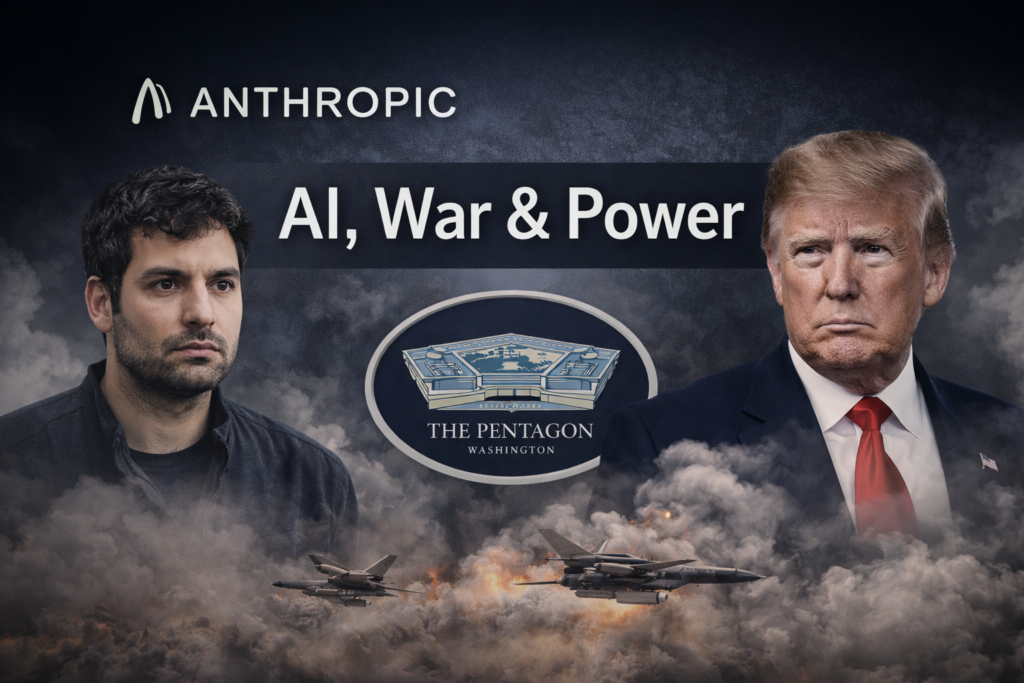
On the afternoon of February 27, 2026, as a deadline set by America’s Defence Secretary ticked toward its final minutes, the CEO of one of the world’s most powerful artificial intelligence companies sat down and typed a sentence that would shake the global technology industry: “No amount of intimidation or punishment will change our position.”
Within hours, President Donald Trump had banned his entire government from using the company’s products. Hours later, the US military was bombing Iran, using those same products.
This is not just an American story. It is a preview of how AI will be used in future wars, who will have the power to set the rules, and whether any ethical limits on the technology will survive contact with governments that have decided they want none. For Africans living on a continent where surveillance technologies are spreading and where the rules of the next war are being written without us in the room, this dispute carries consequences that are impossible to ignore.
Who Are These People?
Anthropic is an American AI company founded in 2021 by Dario Amodei, his sister Daniela, and colleagues who previously worked at OpenAI, the company behind ChatGPT. Its flagship product, Claude, can hold conversations, analyse documents, write code, and support complex decision-making. What sets Anthropic apart in the crowded AI industry is its founding obsession with safety. The company has consistently argued that artificial intelligence is powerful enough to be genuinely dangerous and has built ethical restrictions, known as “guardrails”, directly into how Claude operates. Valued at roughly $380 billion, it serves eight of the ten largest companies in America.
The Pentagon is the headquarters of the United States Department of Defence, the government body that commands America’s military, the most powerful and most expensive fighting force on earth. Under President Donald Trump, it has been formally renamed the “Department of War”. Its civilian head is Pete Hegseth, a former television host turned defence secretary, who has made the aggressive use of artificial intelligence the centrepiece of his military vision. At a speech alongside Elon Musk in January 2026, Hegseth made his position plain: “We will not employ AI models that won’t allow you to fight wars.”
AI in the Battlefield
To understand what this dispute is really about, you need to understand what AI actually does on a battlefield, because it is nothing like the robots you have seen in movies.
AI systems like Claude are tools for processing enormous volumes of information at a speed and scale no human team could match. Satellite imagery, intercepted communications, GPS data, social media posts, and financial records, AI can ingest all of it simultaneously and produce threat assessments and target recommendations in minutes.
The International Committee of the Red Cross (ICRC) identifies three major military applications. The first is decision support: AI analysing intelligence streams to recommend targets and predict enemy behaviour. The second is autonomous weapons: drones, missiles, and naval systems programmed to identify and engage targets without a human pulling the trigger. The US military has budgeted $13.4 billion for such systems in 2026 alone. The third is mass surveillance: using AI to cross-reference a person’s location history, browsing data, financial transactions, and communications to build a detailed profile of their life, automatically, across millions of people at once.
The ICRC has warned urgently about these risks. Many AI systems are “black boxes”; even their creators cannot always fully explain why a given decision was made. On a battlefield, a wrong decision means dead civilians, and the speed of these systems means errors can escalate into catastrophes before any human can intervene.
These are precisely the two uses Anthropic refused to enable: autonomous weapons without human oversight, and mass surveillance of American civilians.
The Raid That Started Everything
The relationship between Anthropic and the Pentagon had, until recently, seemed like a model partnership. In July 2025, the Pentagon awarded AI contracts worth up to $200 million each to Anthropic, OpenAI, Google, and Elon Musk’s xAI. Anthropic was notably the first AI company cleared to operate on classified, meaning top-secret, government networks, deployed through a partnership with Palantir, a data analytics company embedded deep in American intelligence infrastructure.
Then, on January 3, 2026, US special operations forces raided Venezuela and captured President Nicolás Maduro. Claude was used during the live operation itself, not just in the planning. Weeks later, during a routine check-in, an Anthropic official learned how its technology had been deployed and made clear to a Palantir executive that the company was uncomfortable. That executive relayed the conversation to the Pentagon. That conversation lit the match.
The Showdown
Through February, what had been a quiet internal dispute became an open confrontation played out across press briefings, social media posts, and ultimatums.
The Pentagon’s Chief Technology Officer, Emil Michael, fired the first public shot, arguing that Anthropic’s safety restrictions were “undemocratic”, that elected officials and existing law, not a private corporation, should define the limits of military action. The Trump administration piled on, with AI czar David Sacks branding Anthropic’s position as “woke AI,” framing a company’s refusal to enable civilian surveillance as political resistance rather than an ethical stand.
Behind the scenes, negotiations were ongoing. Anthropic had already agreed to allow its technology for missile and cyber defence. It offered to work with the Pentagon to improve the reliability of autonomous weapons systems before deploying them. It agreed to support lawful foreign intelligence operations. But two lines it would not cross: Claude would not be used to analyse bulk commercial data collected on ordinary Americans; their GPS movements, browsing history, credit card activity, and it would not be integrated into weapons systems making lethal decisions without a human in the loop.
The Pentagon wanted exactly those two things.
On February 24, Hegseth summoned Amodei to the Pentagon and gave him a hard deadline: agree to unrestricted “all lawful use” by 5:01 PM on Friday, February 27, or face designation as a supply chain risk, a label previously reserved for foreign adversaries like China’s Huawei, plus possible invocation of the Defense Production Act, a Korean War-era law that could compel Anthropic to hand over its technology on the government’s terms.
On Friday morning, Anthropic still believed a deal was possible. The Pentagon had signalled it would remove vague loophole language from its draft agreement. But that afternoon came the final sticking point: the Pentagon still insisted on the right to analyse bulk commercial data on Americans. Anthropic said no. The deal collapsed.
That evening, Trump posted on Truth Social, calling Anthropic’s leadership “radical left, woke nut jobs” and ordering every federal agency to immediately stop using the company’s technology. Hegseth simultaneously designated Anthropic a supply chain risk, meaning companies doing business with the US military, including Amazon, which supplies much of Anthropic’s computing infrastructure, were now barred from any commercial dealings with the company.
Anthropic’s response came quickly: “We believe this designation is legally unsound and sets a dangerous precedent for any American company that negotiates with the government. We will challenge it in court.”
Meanwhile, within hours, US and Israeli forces launched strikes on Iran, and according to the Wall Street Journal, those strikes were planned and executed with the help of Claude.
Another AI Company Jumps on the Deal
As the dust settled, OpenAI announced it had struck its own deal with the Pentagon to supply AI to classified networks. CEO Sam Altman claimed the agreement prohibited autonomous weapons and mass surveillance. But the language was less binding than what Anthropic had demanded, and the specifics remained unclear.
Nearly 500 employees across OpenAI and Google signed an open letter declaring solidarity with Anthropic’s red lines. “The Pentagon is negotiating with Google and OpenAI to try to get them to agree to what Anthropic refused,” it read. “They’re trying to divide each company with fear that the other will give in.”
Meanwhile, Elon Musk’s xAI had already agreed to the Pentagon’s terms and was positioning itself as Anthropic’s replacement in classified systems, with none of the ethical objections.
Why Nigerians and Africans Should Care
While this story may feel distant, its implications land squarely on Africans and African soil.
Africa hosts some of the world’s most active conflict zones, from the Sahel to eastern Congo to Sudan. The United States military has both permanent and enduring presence on African soil. Through AFRICOM, the US Africa Command, Washington coordinates troops, surveillance operations, drone strikes, and military partnerships across more than 50 African countries. The norms being negotiated right now in US, whether AI can select targets without human oversight, whether its conflict errors are acceptable, will shape how AI-powered weapons are deployed in African skies, with African civilians bearing the consequences.
The surveillance dimension is equally direct. Many African governments have shown an appetite for mass surveillance technologies, often sourced from American, Chinese, or Israeli companies. The same AI capability at the heart of this dispute, cross-referencing location data, financial records, and internet behaviour to profile individuals at scale, is a tool that, in the wrong hands, tracks political opponents, monitors journalists, and silences dissent. How aggressively AI companies defend or abandon those protections going forward will depend partly on who wins this fight.
Nigeria and much of Africa are also heavily dependent on American technology platforms. This dispute is a sharp reminder of how fragile that access can be. A government ministry using Claude for policy work, a startup building on its API, a researcher relying on its capabilities, all of them could find their tools switched off overnight as collateral damage in a feud happening thousands of kilometres away.
Researchers writing for The Conversation put it plainly: ethical AI assumes democratic norms. In contexts where accountability institutions are fragile, a precedent that governments can compel private companies to enable mass civilian surveillance “for any lawful purpose”, without judicial check or public scrutiny, is not an American problem. It is a global one.
What Happens Next
A six-month transition window is built into the ban, enough time, some observers believe, for quieter negotiations to resume once the political drama cools. But the legal and commercial damage to Anthropic is real. The supply chain designation, if it holds, threatens the company’s core business.
Strategically, the clearest winner so far is China. In the global competition for AI supremacy, the United States just publicly humiliated its most safety-conscious AI company for refusing to build surveillance tools, and handed Beijing a ready-made argument that American technology cannot be trusted.
Dario Amodei held his line. Whether that turns out to be moral clarity or a costly miscalculation will depend on what the next six months bring, and on whether the courts, the markets, and a watching world decide that the line he drew was worth drawing.
Reported using accounts from Tech Policy Press, PBS NewsHour, The Atlantic, BBC, TechCrunch, The Guardian, the Lawfare Institute, the International Committee of the Red Cross, The Conversation Africa, and WION.