Expert Urges Community Service for Fine Defaulters to Reduce Cost, Decongest Correctional Centres
Lawrence Nwimo, Awka
An internationally recognised criminologist and prison reform expert, Dr. Uju Agomoh, has said Nigerian government is spending more to feed offenders in correctional centres than the amount of court fines they were unable to pay.
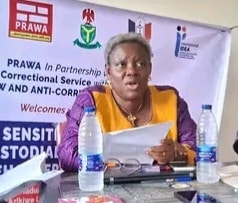
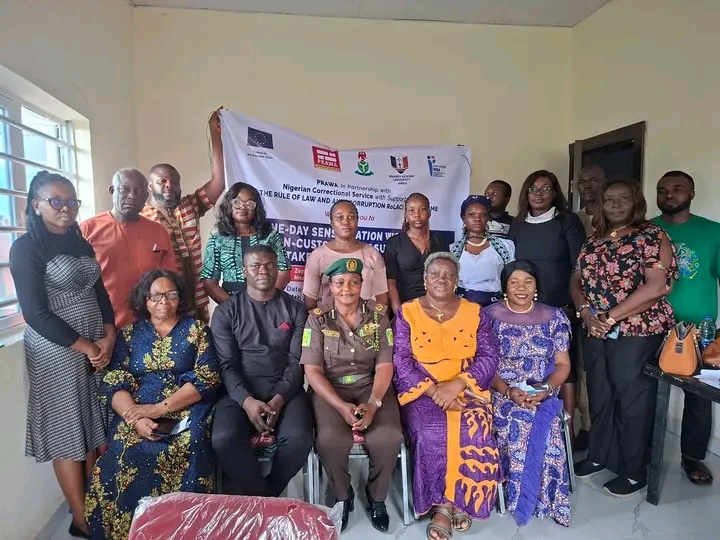
Dr. Agomoh stated this in Nnamdi Azikiwe University, Awka, during a one-day Civil Society Stakeholders’ meeting on Non-Custodial Measures, describing the practice as counter-productive.
The programme was organised by the Prisoners Rehabilitation and Welfare Action (PRAWA) in partnership with the Nigerian Correctional Service, with support from the Rule of Law and Anti-Corruption, RoLAC Programme, under the Advancing the Implementation of Non-Custodial Solutions (AI-NCS) Project.
Speaking at the event, Dr. Agomoh said keeping fine defaulters in custody puts unnecessary burden on the correctional system and public funds.
“It’s like punishing oneself. There is burden on the correctional service in terms of the population, because if you use correctional service for the people who deserve to be there, then the country would be spending less,” she said.
“The essence of community service is for one to be paying something back to the society. Someone did something wrong, instead of paying the society, the person starts receiving free feeding and care from the government. The money government would spend subsequently in feeding the person then exceeds the fine the person was supposed to pay.”
She therefore called for alternatives that allow such persons to serve their fines through community service or other measures that could be equated to the amount owed.
“In community service, you work but you are not paid. The essence is to decongest the correctional centres,” she added.
Agomoh noted that while Nigeria already has legal provisions supporting alternatives to imprisonment, there is need to move beyond laws on paper to effective implementation. She identified probation as one measure that has not received adequate utilisation and institutional attention.
Speaking on the practical realities, the Assistant Controller of Corrections in charge of the Non-Custodial Unit, Anambra State Command, Phibina Nneka Ejiofor, said non-custodial measures such as probation, parole, community service, restorative justice and other court-ordered options help decongest custodial centres and prevent minor offenders from exposure to hardened criminals.
She, however, identified limited public and judicial awareness, inadequate legal and institutional frameworks and gaps in capacity building as challenges affecting implementation.
Earlier in a remark, RoLAC Anambra State Coordinator, Dr. Josephine Onah, represented by Programme Manager, Mr. James Osubor, reaffirmed RoLAC’s commitment to supporting justice-sector reforms and partnerships that promote human rights and effective correctional administration.
Stakeholders at the meeting further examined Sections 12 and 44 of the Nigerian Correctional Service Act, 2019, and advocated for the passage and operationalisation of the Anambra State Correctional Service Bill to strengthen non-custodial justice in the state.
PRAWA said its intervention is anchored on research and advocacy, training, human rights monitoring, rehabilitation, and community justice programmes.